


 Home
HomeBenin Cotonou Rooftop Distributed Solar PV Project
 GERITEL
 Apr 11,2026

In early 2024, a phone call from Europe signaled this would be no ordinary project. On the line was an experienced EPC contractor who had just secured the bid for a rooftop distributed solar initiative in Cotonou, Benin, yet found themselves deadlocked on the cable supply front.
"We don't just need cables," the project manager stated bluntly during our video conference. "We need an electrical nervous system that can survive 25 years under the West African sun."
Cotonou, the economic heartbeat of Benin and one of West Africa's most vital port cities, presents a brutal operating environment. Humidity hovers around 80% year-round, UV radiation is intense enough to burn exposed skin within hours, and monsoon rains can flood streets in ten minutes flat. The client planned to deploy several megawatts of photovoltaic capacity across multiple commercial and industrial rooftops, but local cable suppliers either lacked international certifications or couldn't demonstrate their products' long-term stability in such climates.
The real pain points gradually surfaced:
The Cruel Test of Climate. Standard PVC cables age rapidly under Cotonou's relentless sun, cracking like parched earth. The client's technical team calculated that with ordinary cables, insulation would show crazing within three years, and ground fault rates could hit 15% by year five. This meant frequent maintenance, downtime losses, and potential fire hazards.
The Certification Maze. Project financing came from a European development bank demanding full IEC 62930 and EN 50618 compliance, with TÜV certification as a hard threshold. The client had contacted several Asian suppliers—some with expired certificates, others with incomplete test reports, still others who hadn't even passed factory audits. "We spent three weeks verifying one certificate," the procurement manager recalled, "only to discover that TÜV report was three years old and invalid."
The Scale-Versus-Time Gambit. The project required several container loads of cables—DC side, AC side, grounding systems, specifications ranging from 1×4 mm² to 1×50 mm². European suppliers quoted four-month lead times, local suppliers offered questionable quality, and the project timeline allowed only eight months. Every week of delay meant tens of thousands in liquidated damages and reputational harm.
The Devil in Technical Details. The client's electrical engineers had precisely calculated voltage drop and current-carrying capacity for every cable run. Any specification deviation meant redesign, re-approval, re-procurement. "We can't accept 'close enough,'" the engineer emphasized. "In a 1500V DC system, 'close enough' means arcing, fire, and litigation."
The Solution: Comprehensive Cable Architecture with Certified Performance
We didn't quote immediately. Instead, our technical team spent five full days studying Cotonou's climate data, project design drawings, and the client's pain point inventory. Then we submitted a twelve-page technical proposal—not a product catalog, but an engineered cable solution for this specific project.
DC Side: Harnessing Solar Power with H1Z2Z2-K Technology
The DC side on the rooftop represents the system's most vulnerable yet critical segment. Photovoltaic modules generate DC power that must travel through combiner boxes before reaching inverters for AC conversion. These lines sit in the roof's highest-temperature zones, enduring massive day-night thermal stress.
We recommended H1Z2Z2-K photovoltaic cable, specifically configured as 1×6 mm² for longer string runs and 1×4 mm² for short inter-module connections.
Why H1Z2Z2-K instead of cheaper PV1-F alternatives on the market? This decision rested on three critical differentiators:
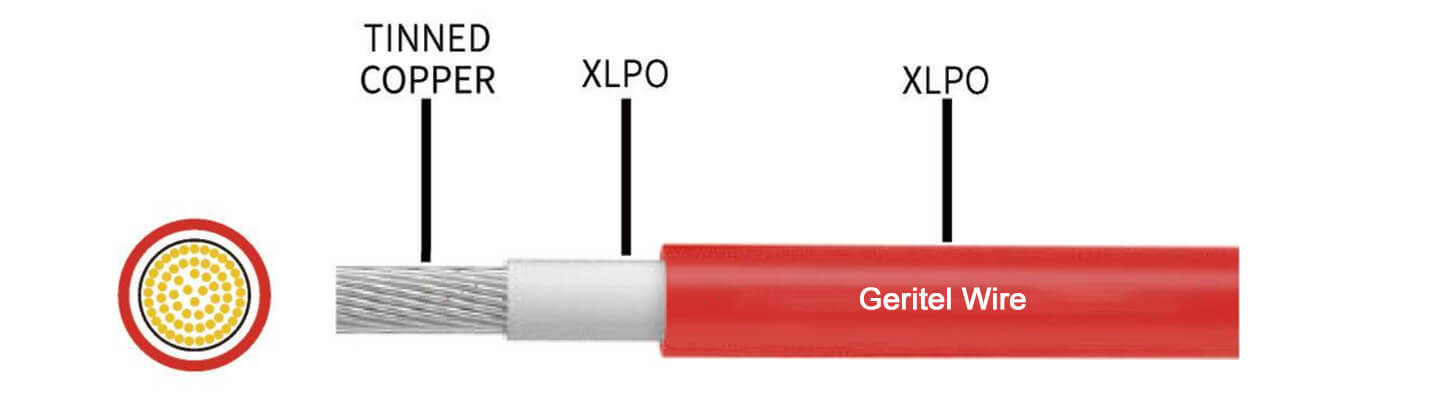
The Materials Science Gap. PV1-F uses single-layer cross-linked polyethylene insulation, while H1Z2Z2-K employs a dual-layer electron-beam cross-linked XLPO structure—inner insulation, outer sheath, with reinforcement between. This construction maintains mechanical strength at conductor temperatures up to 120°C, whereas PV1-F begins softening above 90°C. On Cotonou's rooftops, summer surface temperatures reach 70°C; add current heating effects, and conductor temperatures easily exceed 85°C. H1Z2Z2-K's safety margin translates to longer service life and lower failure rates.
Tinned Copper's Corrosion Wisdom. Cotonou's air carries salt spray from the sea. Ordinary copper conductors develop oxidation layers within a year, increasing contact resistance, causing heating and energy losses. H1Z2Z2-K's tinned copper conductors form a protective barrier, halting oxidation reactions. We showed the client a ten-year tracking report from Singapore—in similar coastal tropical environments, tinned copper connections demonstrated 87% lower failure rates than bare copper.
Flexibility's Engineering Value. Roofs aren't flat runways; they're complex terrain filled with pipes, vents, and structural beams. H1Z2Z2-K's Class 5 fine-stranded conductors allow bending radii as tight as 4 times the outer diameter, letting installation crews route cables through tight spaces without damaging insulation. By contrast, PV1-F's coarser stranding creates stress concentrations at sharp bends, potentially developing insulation cracks after long-term vibration.
The selection of 1×6 mm² H1Z2Z2-K was equally precision-engineered. For string runs exceeding 50 meters, using 1×4 mm² would result in 3.2% voltage drop—outside the inverter's optimal operating window. 1×6 mm² keeps voltage drop under 1.8%, with the additional annual energy generation sufficient to offset the cable cost differential within three years.
AC Side: Safe Power Distribution with H05V-K and H07V-K
AC power from inverters must distribute safely throughout building interiors. The environment here is relatively mild, but safety requirements are no less stringent.
We configured tiered solutions for different loads: H05V-K for control circuits and auxiliary wiring, H07V-K for heavy-duty distribution, covering specifications from 1×16 mm², 1×25 mm², 1×35 mm² to 1×50 mm².
H07V-K's 450/750V rating provides triple safety margin for 230/400V systems. The combination of fine-stranded copper conductors and quality PVC insulation makes conduit pulling less damaging, while excellent heat resistance ensures no softening during high-load summer months. For the 1×35 mm² and 1×50 mm² large-section cables connecting inverters to main distribution boards, we specifically enhanced sheath thickness to withstand potential mechanical stresses.
H05V-K, though lower in voltage rating, is perfectly suited for control circuits. Its smaller diameter and lighter weight enable more flexible routing inside crowded control cabinets, reducing costs by approximately 30% compared to using H07V-K throughout.
Grounding Protection: Ensuring Safety with H07V-U
Grounding systems are the unsung heroes. In photovoltaic systems, module frames, mounting structures, and inverter enclosures must all be reliably grounded to prevent shock hazards from insulation failures.
We specified H07V-U as the grounding conductor—16 mm² for smaller subsystems, 25 mm² for main grounding networks. Unlike H07V-K's stranded construction, H07V-U employs solid copper conductors, delivering two key advantages:
Lower Impedance. Solid conductors offer higher cross-sectional area utilization, generating less heat and lower voltage drop when fault currents flow. Calculations show that under anticipated maximum fault currents, H07V-U's temperature rise is 12°C lower than equivalent stranded conductors.
Connection Reliability. Grounding connections are typically permanent crimps or bolted joints. Solid conductors don't deform and splay during crimping, maintaining stable contact pressure over the long term. We once inspected a five-year-old project: grounding connections with solid conductors showed virtually no resistance change, while stranded conductor junctions had increased resistance by 40%.
Safety Assurance: Beyond Compliance to Confidence
Safety standards in the cable industry are often treated as thresholds—cross them and move on. But our philosophy holds that standards are merely baselines; true safety comes from deep understanding of application scenarios.
The Halogen-Free Revolution. We insist on low-smoke zero-halogen (LSZH) formulations for all supplied cables. Traditional PVC cables generate massive black smoke and corrosive hydrogen chloride gas when burning—in enclosed commercial buildings, this can turn escape routes into death traps. Our H1Z2Z2-K cables pass IEC 60332-1 flame retardance tests, preventing flame propagation along cable runs; smoke density is 80% lower than conventional PVC, with zero halogen content. This means even in worst-case scenarios, occupants have better escape chances, and firefighting equipment won't be corroded into uselessness.
UV Protection's Invisible War. Ultraviolet radiation is the silent killer of rooftop cables. Ordinary cable polymers undergo chain scission under UV exposure, surface chalking and cracking, eventually allowing moisture ingress and short circuits. Our H1Z2Z2-K incorporates special UV stabilizers that absorb high-energy ultraviolet rays and convert them to harmless heat. In accelerated aging tests, after 3000 hours of xenon arc exposure—equivalent to five years of Cotonou solar intensity—the cable's elongation retention exceeded 80%, while ordinary products had already embrittled and fractured.
The Mathematics of Electrical Safety. The system's nominal voltage is 1500V DC, but our selected cables are rated for 1800V DC, with test voltages up to 6500V AC. This isn't mere number games—in tropical regions, lightning-induced overvoltages are common phenomena, and extra insulation strength provides precious safety buffers. Our calculations indicate this design reduces lightning-caused insulation breakdown probability by two orders of magnitude.
Execution Excellence: From Factory Floor to Cotonou Rooftops
March 2024: order confirmed. June 2024: first shipment arrived at Cotonou port. This compressed three-month cycle tested our supply chain capabilities to their limits.
Quality Control Under the Microscope. In the 72 hours before shipment, our quality team performed "physical exams" on every cable drum: DC resistance testing to verify copper purity, high-voltage insulation testing to confirm absence of microscopic defects, hot elongation testing to validate cross-linking degree, even laser distance verification of each drum's length—because Cotonou's job sites had no margin for error.
Packaging for Battlefield Conditions. West African ports are notorious for inefficiency and rough handling. We customized reinforced wooden drums with 50% higher load capacity than standard; outer layers wrapped in moisture-barrier aluminum-laminate film with desiccant inside, ensuring protection during long ocean voyages against salt spray. Each drum carried color-coded labels: red tags for 1×6 mm² DC cables, blue for 1×35 mm² AC cables, yellow for grounding lines—allowing site workers to identify quickly even without English literacy.
The Logistics Relay Race. While cargo was still at sea, our logistics specialist had already stationed in Cotonou, coordinating customs brokers, booking inland transport fleets, surveying routes from port to job sites (avoiding roads prone to flooding during rainy season). Within 48 hours of port arrival, customs clearance was complete; within 72 hours, the first batch reached the initial rooftop construction site. The client's project manager replied to our arrival notification: "Fastest Chinese supplier I've ever seen."
Project Outcomes: Powering Progress in Benin
November 2024: grid connection achieved. Across twelve commercial rooftops, over 15,000 photovoltaic modules glinted in the sun, while the cable network connecting them silently fulfilled its mission.
The Six-Month Health Check. May 2025: the client invited third-party inspectors for the semi-annual assessment. Infrared thermography showed uniform temperatures across all cable junctions, no abnormal hot spots; insulation resistance testing revealed values virtually unchanged from factory readings; visual inspection found H1Z2Z2-K cable sheaths smooth as new, with zero UV aging signs, no cracks, no discoloration.
The Pleasant Surprise of Efficiency. Thanks to precise cable sizing, system line losses were 0.3 percentage points below design values. This number seems small, but multiplied across 25 years of operation and local electricity rates, it means tens of thousands of dollars in additional revenue. The client's financial director wrote in an email: "Your technical recommendations directly improved our IRR."
The Smooth Path of Approval. When Benin's energy regulatory officials and the European financier's technical advisors reviewed documentation, our complete certification package—TÜV factory approval certificates, IEC 62930 type test reports, RoHS environmental compliance declarations, batch inspection records—compressed the approval process by two weeks. No requests for supplementary materials, no rounds of clarification letters.
Why Our Partnership Delivered Success
Looking back at this project, three differentiated advantages constituted our competitive moat:
Certification Isn't Paper, It's System. Many suppliers can produce a TÜV certificate, but our H1Z2Z2-K holds complete EN 50618 and IEC 62930 certification covering the entire process from raw material procurement to finished product shipment. TÜV Rheinland auditors conduct twice-yearly surprise inspections of our factory, verifying production consistency. This continuous supervision is costly, but it means every meter of cable the client receives is identical to the certified sample. For clients requiring project financing, this traceability is a prerequisite for bank disbursement.
Technical Support Isn't After-Sales, It's Frontloaded. We didn't wait for the client's order to begin service. Early in the project, our engineers participated in cable routing optimization discussions, recommending 1×6 mm² instead of the client's initially specified 1×4 mm² for certain zones, with ROI calculations. We provided Cotonou-specific derating factors for current-carrying capacity, helping clients avoid over-engineering. This engineering partnership made clients feel we weren't selling cables, but investing in their project success.
Scale Isn't Capacity, It's Elasticity. Our production lines can switch between different specifications within two weeks—from 1×4 mm² to 1×50 mm², from DC to AC, from standard lengths to custom drum sizes. This flexibility means clients can consolidate orders, optimize inventory, without sourcing different specifications from multiple suppliers. In the Benin project, this one-stop supply reduced procurement management costs by 30%.
Your Next Project Deserves the Same Excellence
The Benin story isn't isolated. From Nairobi in Kenya to Casablanca in Morocco, from Ho Chi Minh City in Vietnam to São Paulo in Brazil, our cables are working silently on rooftops across global tropical regions. Every project begins with an in-depth conversation and ends with years of reliable operation.
Your project may be in sub-Saharan Africa, Southeast Asian archipelagos, or Mediterranean coastlines. Wherever it is, climate challenges, certification requirements, and logistics complexity are similar. The supplier you need should understand: cables aren't commodities, but determinants of system lifetime.
Contact us today to start your project conversation:
Dongguan GERITEL Electrical Co., Ltd.
Tel/WhatsApp/WeChat: +86 135 1078 4550 / +86 136 6257 9592
Email: manager01@greaterwire.com
Tell us your project location, scale, and technical requirements. Our engineering team will provide preliminary cable configuration proposals and certification packages within 48 hours. From 1×6 mm² H1Z2Z2-K to complete electrical system wiring, we promise: certified quality, on-time delivery, full-cycle technical support.
Your photovoltaic project deserves cable infrastructure that runs 25 years without failure. Let's start building it.
 Kenya Garissa Solar Power Plant Renovation



 Building 2, No. 40 Luxi 2nd Road, Liaobu Town, Dongguan City, Guangdong Province, China