


 Home
Home4/C PVC Jacketed MC Cable with Ground: What Buyers Should Check Before Ordering
 GERITEL
 May 28,2026

You’re looking at a 4/C PVC jacketed MC cable with a dedicated ground. But is it the right choice for your multi‑family residential building or outdoor installation? Before you place an order, let’s go through what the specification actually means – and what you should verify.
This article focuses on three common 4/C configurations: 3 AWG 4/C XHHW-2, 2 AWG 4/C XHHW-2, and 6/4 THHN/THWN-2 with PVC jacket and ground. Each has different insulation, conductor size, and application fit.
1.Why 4/C with Ground? The Real Advantage
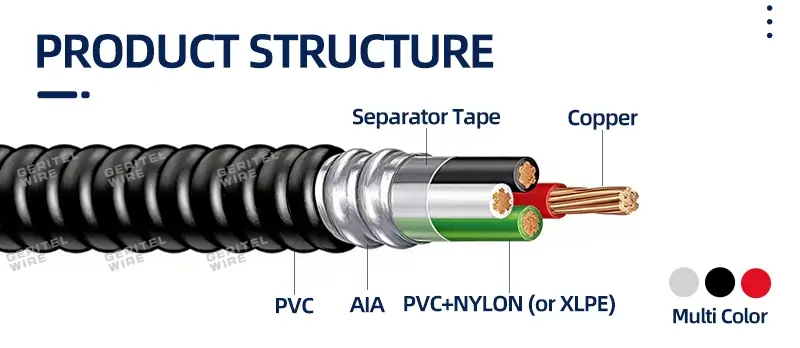
A 4/C MC cable contains three phase/neutral conductors + one dedicated grounding conductor. Compared to 3/C (where ground is sometimes bare or reduced size), a 4/C with an insulated green/yellow ground gives you:
- Full isolation – no contact between ground and armor, eliminating galvanic corrosion risks.
- Cleaner termination – easier to identify and land in panels.
- Code compliance – many projects now require an insulated equipment grounding conductor.
The ground in our 4/C cables is full size (same AWG as the phase conductors), not a smaller reduced ground. That means lower impedance, faster fault clearing, and safer installations.
2.Three Common 4/C Specifications – What Each Delivers
3 AWG 4/C XHHW-2 MC cable with ground PVC jacket
- Insulation: XHHW-2 (cross‑linked polyethylene). Rated 90°C wet/dry, excellent moisture & chemical resistance.
- Conductor size: 3 AWG – ampacity around 100–115A (copper, 90°C).
- Best for: Main feeders to multi‑family residential buildings (apartment panels), light commercial feeders, and outdoor runs where moisture is present.
2 AWG 4/C XHHW-2 MC cable with ground PVC jacket
- Insulation: XHHW-2.
- Conductor size: 2 AWG – ampacity around 130–145A.
Best for: Larger feeders from transformer to main distribution panel, or serving several residential units.
6/4 THHN/THWN-2 MC cable with PVC jacket and ground
“6/4” means 6 AWG, 4 conductors (3 phases + ground). Insulation is THHN/THWN‑2 – thermoplastic, rated 90°C dry / 75°C wet (or 90°C wet for THWN‑2). Compared to XHHW‑2:
- XHHW-2 gives better cold bend (-40°C) and chemical resistance, at higher cost.
- THHN/THWN-2 is more budget‑friendly, suitable for dry or damp indoor runs and conduit installations.
Best for: Dry or damp indoor runs, conduit installations, and projects with budget constraints.
3.What Buyers Should Check – 4 Key Points
UV resistance of the PVC jacket
Outdoor installations (even above ground) demand UV‑stabilized PVC. Without it, the jacket cracks in 12–18 months.
Ask your supplier: “Is the PVC jacket sunlight resistant?” Our 4/C PVC jacketed MC cable uses UV‑resistant compounds – no cracking, no premature failure.
Ease of wall penetration & bending
Running cable through studs, concrete walls, or tight floor penetrations requires flexibility.
- Aluminum interlocked armor (AIA) is lighter and more flexible than steel.
- XHHW‑2 insulation is naturally slick – no lubrication needed for pulling.
Check the armor type: AIA saves labor on multi‑family projects where cable snakes through many unit walls.
Mechanical damage resistance
Accidental impact from tools, ladders, or construction debris is common. MC cable’s metal armor (AIA or steel) protects conductors.
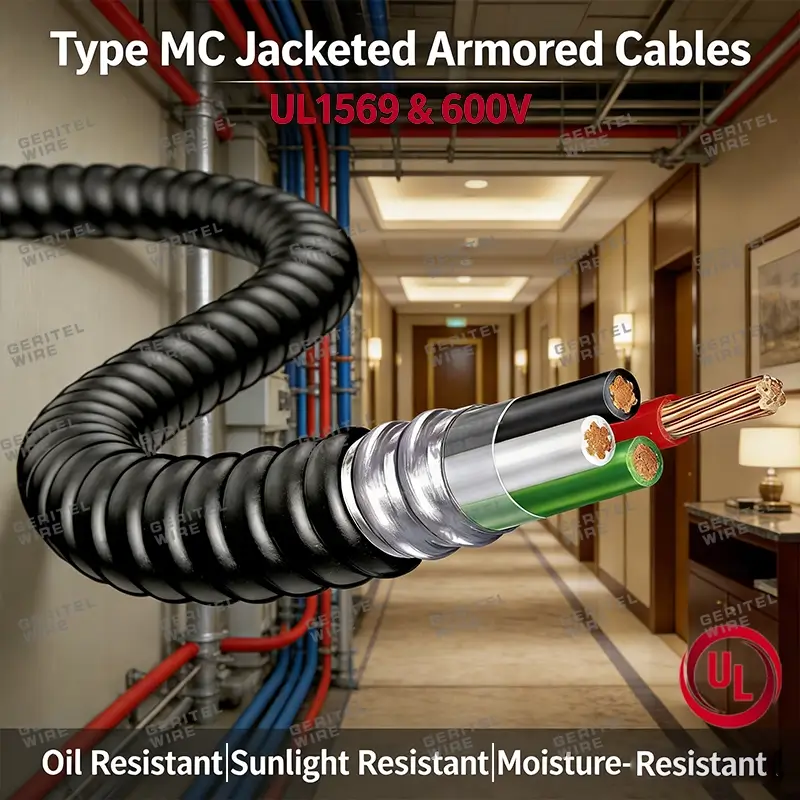
Verify armor thickness meets UL 1569 – our cables are UL 1569 listed and have passed impact tests.
Grounding conductor insulation
A bare copper ground can corrode when in contact with dissimilar metals (e.g., aluminum armor in wet conditions).
Our 4/C cables come with a genuine, full‑size green/yellow insulated ground – not a reduced gauge, not a fake. This ground conductor is real copper, sized the same as the phase conductors, and insulated to prevent any contact with the armor. Perfect for direct burial (where local code permits) or any environment with potential electrochemical corrosion.
4.Application Focus: Multi‑Family Residential & Outdoor
Multi‑family residential buildings (apartments, condos, dormitories)
Typical setup:
- Transformer → 2 AWG 4/C XHHW-2 main feeder to building distribution panel.
- From distribution panel → 3 AWG or 6 AWG sub‑feeders to each floor or unit.
- Why 4/C with ground? – Isolated ground prevents circulating currents and meets modern code requirements for residential multi‑unit grounding.
Outdoor installations (exposed or direct buried – verify local code)
- PVC jacket provides moisture and UV protection.
- Aluminum interlocked armor resists corrosion (better than steel outdoors).
- Insulated green ground prevents galvanic issues when buried.
Note on direct burial: UL 1569 MC cable may or may not be rated for direct burial. We do not claim direct burial suitability unless explicitly stated on the datasheet. Always check with your local AHJ (Authority Having Jurisdiction).
5.UL 1569 Certification – What It Actually Means
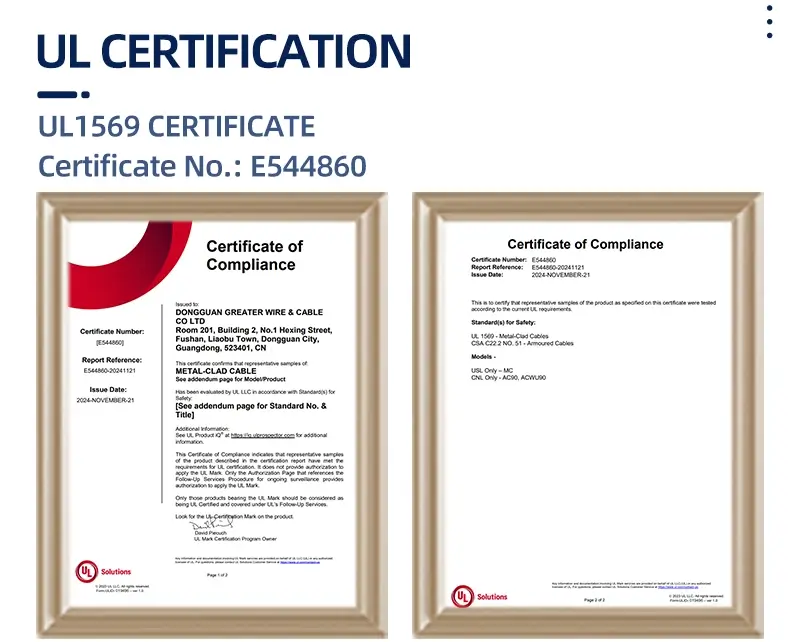
Our 4/C PVC jacketed MC cables are UL 1569 Listed. This is not just a label – it means the cable has passed specific third‑party tests required by UL for metal‑clad cable:
- Armor impact test – the cable withstands a defined drop weight without damage to insulation.
- Armor crush test – the armor resists crushing forces that could pinch conductors.
- Temperature rating verification – the cable meets its stated 90°C rating under continuous load.
- Voltage withstand test – the insulation holds rated voltage (600V) without breakdown.
- Conductor and ground continuity – the ground path is verified as real and continuous.
And specifically about the grounding conductor: the green/yellow insulated ground inside our 4/C cables is real, full‑size copper, not a smaller gauge, not a substitute, not a cosmetic layer. It is factory‑tested for continuity and insulation integrity. You can rely on it as a true equipment grounding conductor.
We never use fake or undersized grounds. Every reel comes with traceable UL file numbers – ask us for the documentation.
6.Selection Reminder: Why 4/C with Insulated Ground?
Buyers often ask: “Can’t I just use 3/C and rely on the armor as ground?”
The answer: Sometimes yes, but not always.
- Armor alone may not provide a low‑impedance path, especially after corrosion.
- Insulated ground guarantees a dedicated return path, required by NEC for many feeders (e.g., feeders to separate buildings, or where ground fault protection is needed).
Our recommendation for multi‑family and outdoor projects: Always choose 4/C with an insulated green/yellow ground. The small upfront cost difference eliminates long‑term risks.
FAQ
Q1: Can I use 4/C THHN/THWN-2 MC cable outdoors?
Yes – if the PVC jacket is sunlight resistant and the cable is rated for wet locations (THWN-2). However, XHHW-2 offers better cold weather and chemical resistance for harsh outdoor environments.
Q2: What’s the ampacity of 3 AWG vs 2 AWG copper in 4/C MC cable?
At 90°C insulation: 3 AWG ≈ 100–115A, 2 AWG ≈ 130–145A. Exact values depend on ambient temperature and bundling – refer to the manufacturer’s datasheet.
Q3: Do you offer steel armor instead of aluminum?
Yes, we offer both. Aluminum is lighter and corrosion resistant; steel is stronger but heavier. For outdoor residential projects, aluminum is the common choice.
Q4: Is the ground conductor in your 4/C cables always insulated and full size?
Yes – always. Full size (same AWG as phase conductors), real copper, with green or yellow/green insulation. No exceptions.
Need a specification check before you order?
Choosing between 3 AWG, 2 AWG, or 6/4 – and between XHHW-2 vs THHN/THWN-2 – depends on your actual load, run length, and installation environment. Tell us your project type (multi‑family residential, outdoor feeder, etc.), and we will recommend the exact 4/C configuration with UL 1569 certification.
Contact Us
Dongguan GERITEL Electrical Co., Ltd.
Tel/WhatsApp/Wechat: +86 136 6257 9592
Tel/WhatsApp/Wechat: +86 135 1078 4550
Email: manager01@greaterwire.com
Website: www.geritelgroup.com
 PVC Jacketed MC Cable with Aluminum Interlocked Armor: Benefits and Use Cases



 Building 2, No. 40 Luxi 2nd Road, Liaobu Town, Dongguan City, Guangdong Province, China