


 Home
HomeWhat Does “PVC Jacketed” Mean in MC Cable Specifications?
 GERITEL
 May 27,2026

For new electrical technicians, entry-level procurement staff, and cable sales distributors, MC cable specification sheets are often full of ambiguous jargon. Among the most commonly misunderstood terms is PVC jacketed — a key feature that differentiates premium MC cable from standard bare armored alternatives. Many industry buyers confuse PVC jacket functionality with waterproofing, fail to distinguish PVC-jacketed MC cable from bare interlocked armor models, and even overpay for unnecessary upgraded products due to unclear spec parameters.
In this guide, we break down exactly what PVC jacketed means in MC cable designs, resolve core specification confusion, compare real-world performance differences, and deliver actionable selection rules for electrical project planning and procurement. We’ll integrate common industrial specs including 250 kcmil 4/C XHHW-2 MC cable with ground PVC jacket, 300 kcmil 3/C XHHW-2 PVC jacketed MC cable, and 4/0 AWG 4/C XHHW-2 MC cable with ground PVC jacket, while clarifying critical industry terms like XHHW-2, aluminum interlocked armor, and RoHS compliance for poly coat MC cable.
1. What Is a PVC Jacketed MC Cable?
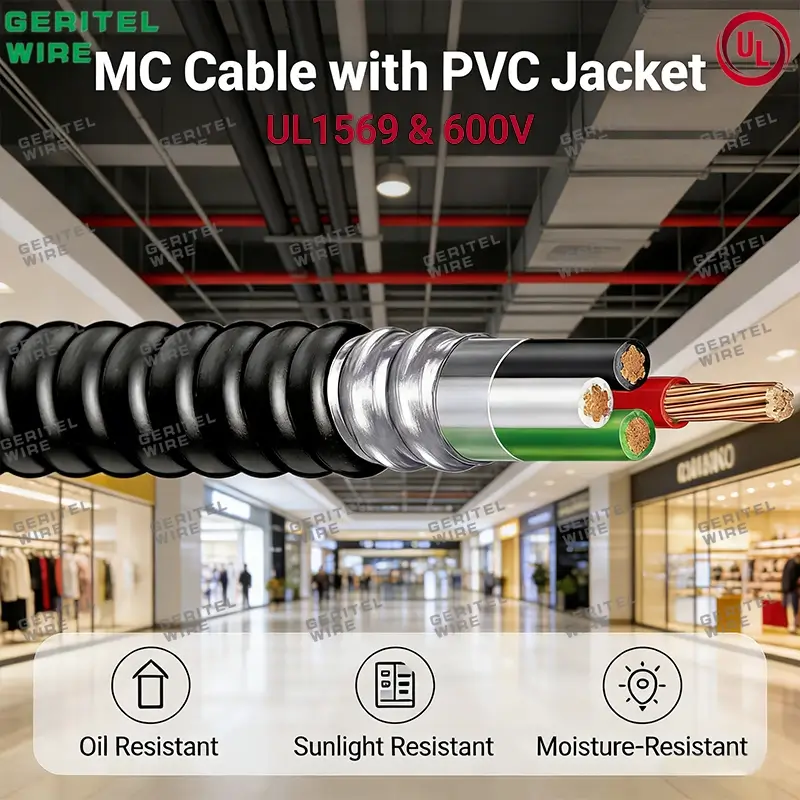
A PVC jacketed MC cable is a metal-clad electrical cable with a complete polyvinyl chloride outer protective layer applied over its metal armor base. Unlike bare armored MC cable that leaves interlocked metal armor exposed, PVC jacketed MC cable adds a continuous polymer coating to seal and protect the entire cable core system. All standard models operate at 600V rated voltage, matching universal commercial and industrial power distribution requirements.
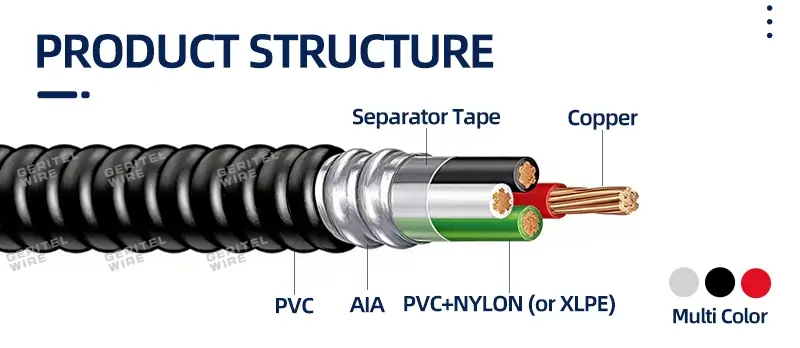
The defining value of this cable lies in its three-layer PVC protective structure, a key advantage over bare armor designs that most entry-level buyers overlook:
· Inner buffer layer: Separates the internal insulated conductors (XHHW-2/THHN/THWN-2) from metal armor, eliminating friction damage during bending and installation. This protects both bare ground and insulated green ground configurations across 3/C and 4/C cable setups.
· Middle armor barrier: Seals the gaps of aluminum interlocked armor or galvanized steel armor, blocking dust, moisture, and minor chemical corrosion from penetrating the cable core.
· Outer PVC protective jacket: The visible exterior layer that delivers abrasion resistance, environmental isolation, and standardized surface durability for general and light industrial use.
This three-tier structure is why poly coat MC cable outperforms bare armored MC cable in harsh indoor and semi-exposed environments, resolving the common pain point of unrecognized structural protection gaps in basic MC cables.
2. PVC Jacketed vs. Bare Armor MC Cable: Critical Performance & Use Case Contrast
The biggest procurement mistake buyers make is treating PVC jacketed and bare armor MC cable as interchangeable. The two designs serve entirely different environmental scenarios, and misselection leads to premature failure or wasted budget. Below is a practical, project-focused comparison to eliminate specification confusion.
· Core Performance Differences
Bare armored MC cable relies solely on interlocked metal armor for protection. While it offers basic mechanical strength, its open armor gaps allow moisture, dust, and corrosive fumes to seep into the core over time. In contrast, the full PVC outer enclosure of jacketed models delivers consistent environmental isolation.
For example, the 300 kcmil 3/C XHHW-2 PVC jacketed MC cable maintains stable insulation performance in humid factory interiors and mechanical rooms, while its bare armor counterpart is prone to core insulation degradation in the same conditions. For heavy-duty power distribution, the 250 kcmil 4/C XHHW-2 MC cable with ground PVC jacket protects 4-circuit power setups with full perimeter sealing, ideal for multi-load industrial systems.
· Scenario-Based Selection Split
Choose Bare Armor MC Cable: Dry, fully enclosed indoor spaces (standard ceiling plenums, sealed cable trays) with no moisture or chemical exposure. It is cost-effective for low-risk, routine indoor wiring projects.
Choose PVC Jacketed MC Cable: Humid indoor areas, mechanical rooms, corridor wiring, and areas with minor abrasion or dust exposure. The 4/0 AWG 4/C XHHW-2 MC cable with ground PVC jacket is widely used for mid-sized commercial power runs due to its balanced durability and cost efficiency.
3. PVC Jacketed MC Cable Weight Reference (Per 1000 ft) for Accurate Project Planning
Weight is a vital overlooked parameter for logistics, bracket load calculation, and on-site construction scheduling—one of the top searched long-tail questions for this product line. Below are industry-standard weight benchmarks for common PVC jacketed MC cable specifications to support precise procurement and project planning:
· 4/0 AWG 4/C XHHW-2 PVC jacketed MC cable (with ground): Moderate weight density, suitable for vertical and horizontal tray installation without excessive bracket load stress
· 250 kcmil 4/C XHHW-2 PVC jacketed MC cable (with ground): Higher conductor cross-section increases overall cable weight, requiring reinforced hanging hardware for long-span runs
· 300 kcmil 3/C XHHW-2 PVC jacketed MC cable: Optimized 3-core layout balances weight and power capacity, ideal for single-load heavy industrial power distribution
Compared to bare armor equivalents, PVC jacketed MC cable has a slight weight increase due to the polymer outer layer, but the marginal weight gain delivers far superior environmental protection, making it a worthwhile upgrade for non-dry environments.
4. Non-Negotiable Selection Rules
Most specification errors stem from three false assumptions about PVC jacket performance. These rules eliminate misselection and prevent suppliers from pushing overpriced, unnecessary upgrades.
· PVC Jacket ≠ Waterproof Rating
A standard PVC outer jacket provides dust and humidity resistance but does not qualify for waterproof or direct burial use. For wet-location installations, you must verify the coreXHHW-2 or THWN-2 insulation rating separately. XHHW-2 insulation delivers inherent wet-location performance, while the PVC jacket acts only as external mechanical and environmental protection—never rely on the jacket alone for water resistance.
· Outdoor Use Requires Explicit “Sunlight Resistant” Marking
Generic PVC jackets degrade rapidly under UV radiation, cracking and peeling after prolonged sun exposure. Only PVC jacketed MC cable explicitly labeled Sunlight Resistant is approved for outdoor exposed runs. Standard poly coat MC cable is strictly for indoor or shielded outdoor applications.
· RoHS Compliance Verifies Environmental Eligibility
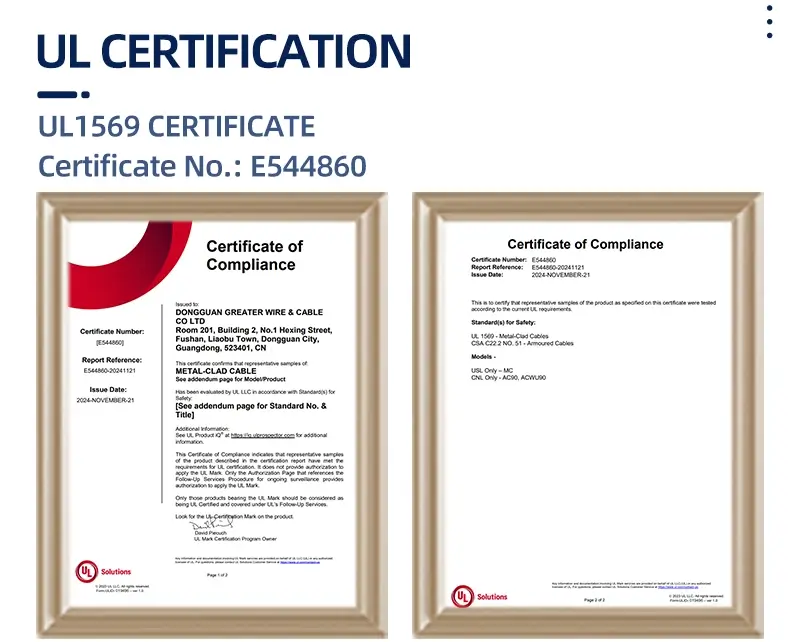
For commercial projects, government tender jobs, and green building certifications, PVC jacketed MC cable RoHS compliance is mandatory. RoHS certification confirms the jacket material contains no restricted hazardous substances, meeting modern environmental safety standards. Always confirm RoHS documentation during supplier comparison to avoid non-compliant product rework.
5. Frequently Asked Questions (FAQ)
Q1: What is PVC jacketed MC cable in simple terms?
It is a standard 600V metal-clad cable with a full PVC outer polymer coat over aluminum or steel interlocked armor. It adds dust, humidity, and abrasion protection that bare armor MC cable lacks, designed for indoor and shielded commercial/industrial wiring.
Q2: Is PVC jacketed MC cable suitable for direct burial?
No. The PVC jacket provides environmental protection but no direct burial rating. Buried applications require specialized burial-rated cables, regardless of PVC jacket presence.
Q3: Does PVC jacket type affect cable weight per 1000 ft?
Yes. The PVC outer layer adds consistent marginal weight versus bare armor designs. Larger kcmil/AWG sizes (300 kcmil, 250 kcmil, 4/0 AWG) show more noticeable weight differences critical for structural load planning.
Q4: Do all PVC jacketed MC cables meet RoHS standards?
No. RoHS compliance is a separate certified attribute. Always request formal RoHS test reports from suppliers for green building and compliant project requirements.
6. Quick Buying & Spec Comparison Takeaway
PVC jacketed MC cable solves the core limitations of bare armor MC cable with its three-layer protective structure, delivering reliable dust, humidity, and abrasion resistance for general industrial and commercial wiring. For entry-level teams, the key to smart procurement is simple: use bare armor for dry, fully protected indoor trays, and select certified PVC jacketed poly coat MC cable for humid, dusty, or semi-exposed environments. Always cross-check XHHW-2 insulation ratings, sunlight resistance labeling, and RoHS compliance to avoid misselection and overspending.
Need tailored spec sheets, exact PVC jacketed MC cable weight data, or RoHS compliance documents for your 250 kcmil, 300 kcmil, or 4/0 AWG project requirements? Send us a quick inquiry for fast, project-specific pricing and technical verification support.
Dongguan GERITEL Electrical Co., Ltd.
Tel/WhatsApp/Wechat: +86 136 6257 9592
Tel/WhatsApp/Wechat: +86 135 1078 4550
Email: manager01@greaterwire.com
Website: www.geritelgroup.com
 How to Read PVC Jacketed MC Cable Specifications Before Ordering



 Building 2, No. 40 Luxi 2nd Road, Liaobu Town, Dongguan City, Guangdong Province, China