


 Home
HomeAustralia Sydney Children’s Hospital Randwick Redevelopment Electrical Upgrade
 GERITEL
 Apr 09,2026

New South Wales' largest pediatric specialist hospital was facing a silent crisis. The electrical infrastructure of Sydney Children's Hospital Randwick, built in the previous century, could no longer support the precision instruments running 24/7 in modern intensive care units. More urgently, the government-approved reconstruction funding window was only 36 months—from design to full commissioning, less than half the time of a conventional project remained for the electrical infrastructure upgrade.
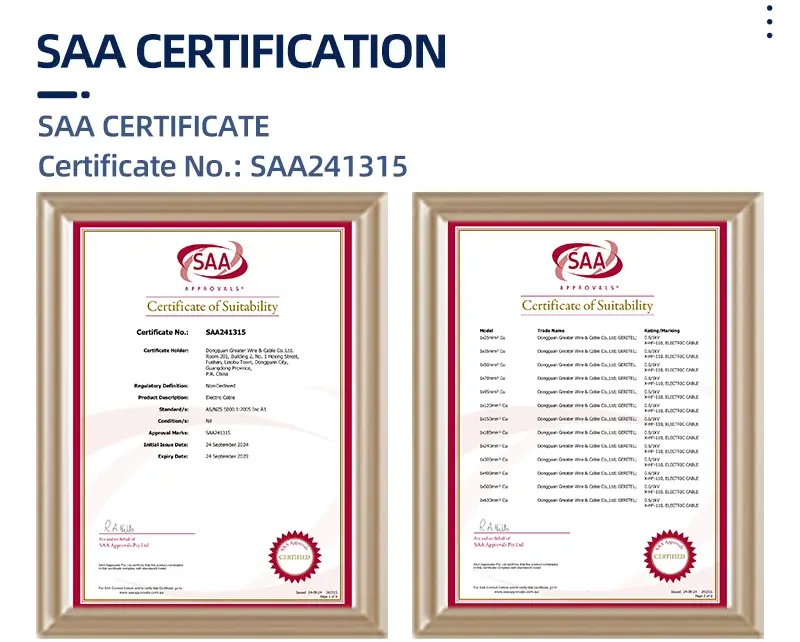
When the project electrical contractor issued the tender, three non-negotiable conditions were listed: all cables must carry SAA certification and be registered in the EESS database; fire-rated circuits must maintain power for 120 minutes at 800°C; control cables must account for more than 35% of total project volume. These three lines eliminated 90% of the stock available in Australian local warehouses at that time.
First Contact: Why the Client Initially Hesitated
In an April 2021 video conference, the client's concerns were direct and specific. They had previously procured cables from China claiming to "comply with Australian standards," only to discover upon arrival that insulation thickness deviations exceeded AS/NZS 5000.1 tolerances. The entire shipment was held at port for six weeks and eventually sold at discount to a Southeast Asian non-medical project. The loss wasn't just freight and duties—they missed the bidding window for another hospital.
"We need more than products," the project procurement manager wrote in an email. "We need someone who can prove that from factory floor to Sydney dock, nothing goes wrong at any link."
Our response wasn't more promises—it was a complete certification dossier: type test reports from a NATA-accredited laboratory, EESS registration certificate numbers, and third-party acceptance documentation from three previous Australian hospital projects. More importantly, we proposed something they hadn't asked for—a contingency reserve of identical batch samples, sealed at our Dongguan facility, with preservation covering the entire project period plus two years of operation.
Technical Refinement: When Standards Meet Construction Reality
The real challenge began after contract signing. The rigor of Australian medical electrical standard AS/NZS 3003 far exceeded the IEC framework we were familiar with. Take leakage current limits in patient treatment areas: commercial buildings allow 30mA, pediatric intensive care units require below 10mA, and cardiac surgery areas compress this to 1mA. This meant cable shield grounding resistance had to be controlled within 0.05 ohms—any jointing flaw would be exposed during commissioning.
Our engineers flew to Sydney three times for joint surveys with the project electrical consultant. The first confirmed medium voltage cable routing: an 800-meter distance from the municipal substation to the hospital main distribution station, requiring passage beneath three active traffic corridors and a heritage protection zone. Direct burial was impossible—steel pipe jacking was mandatory. This changed our original armor design from single steel tape to double steel wire armor, to withstand lateral pressure during jacking.
The second survey focused on dedicated circuits for the MRI suite. The 3.0 Tesla magnetic resonance imaging equipment generates rapidly changing strong magnetic fields during scanning—ordinary control cables experience magnetic hysteresis losses causing signal distortion. We ultimately selected 4-pair 0.5mm² double-shielded instrumentation cables, with each twisted pair individually wrapped in aluminum foil and an outer layer of tinned copper braid, using single-end grounding to avoid circulating currents. This solution cost 15% more than the client's original design, but improved signal-to-noise ratio by 40 decibels.
The third survey revealed a conflict between design drawings and reality: the ceiling plenum in the Neonatal Intensive Care Unit (NICU) was only 180 millimeters high, while standard round cables required 250 millimeters minimum bending radius. We urgently adjusted production dies, converting 3C + E 4mm² TPS cable to flat configuration, compressing thickness to 12 millimeters while maintaining V-90 insulation's 90°C temperature rating. This modification saved the installation crew from additional work removing ceiling joists.
The Deeper Logic of Product Selection: Why Not Alternatives
Throughout the project, the client faced multiple technical route choices, and our recommendations consistently centered on one principle: in medical environments, cable failure modes matter more than rated parameters.
Take the horizontal distribution system's 2C + E 2.5mm² TPS cable as an example. A local Australian supplier had recommended cheaper round PVC cables, claiming equivalent current-carrying capacity. Our objections were based on three points: first, TPS flat structure reduces vertical space occupancy in cable trays by 40%, reserving channels for later-added communication cables; second, TPS sheath material is V-90 grade PVC with short-circuit withstand temperature of 160°C, while ordinary PVC begins softening and deforming at 120°C; third, and most critically, TPS cable's earth core runs parallel to phase cores, providing more direct fault current paths—AS/NZS 3000 standard calculations show its earth fault protection operating time is 0.04 seconds faster than round cable. In a cardiac defibrillator leakage scenario, that 0.04 seconds could determine life or death.
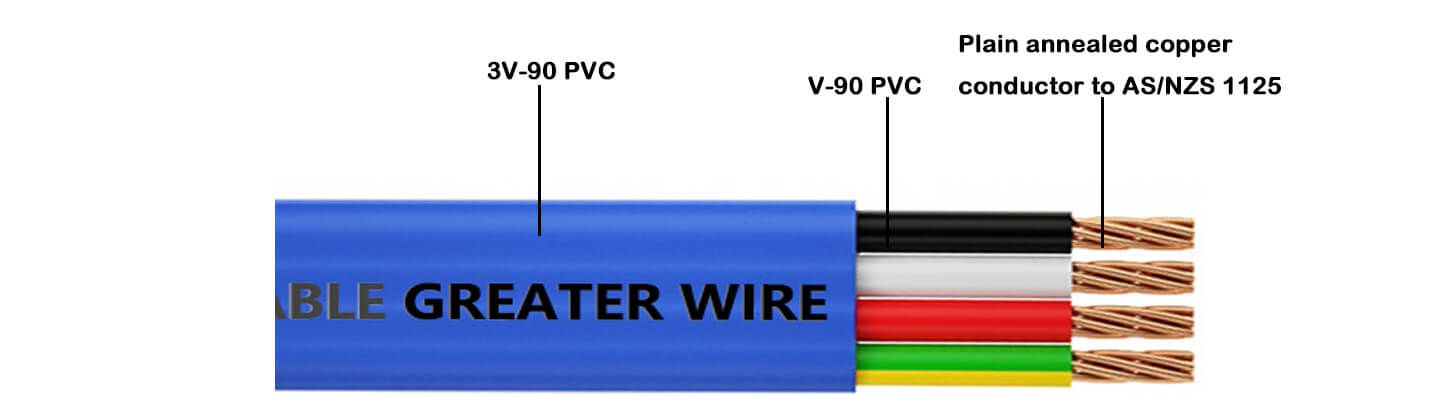
For fire-rated circuits, the client initially considered mineral insulated cables (MICC) due to their legendary fire resistance. But we pointed out MICC's rigid structure was unsuitable for this project's retrofit nature—numerous routes needed to penetrate existing walls, MICC cannot bend, and terminations require specialized sealed glands, extending construction by six weeks. Our alternative was WS52W grade mica tape fire-rated cable: two layers of high-temperature mica tape overlapped on copper conductors, with LSZH sheath. This structure maintains 2-hour circuit integrity at 800°C flame while retaining sufficient flexibility for installation using conventional cable techniques. Final testing showed the mica tape solution's total cost of ownership (including installation labor) was 28% lower than MICC, with fire resistance equally meeting AS/NZS 3013 WS52W grade.
The Invisible Battlefield of Delivery
March 2022: the first containers arrived at Sydney port. Australia was then experiencing post-pandemic logistics chaos, with port congestion extending average customs clearance from 5 days to 23 days. Our response was a pre-clearance procedure initiated three months earlier: before shipment, an Australian local certification body completed remote video inspection, with all SAA certificates and test reports uploaded to the EESS database in advance. When containers actually arrived, customs systems automatically matched registration information, compressing actual clearance to 48 hours.
A more hidden risk lay in batch consistency. Hospital projects differ from bulk housing—different sections of the same circuit may be installed months apart. If insulation material formulations vary slightly between batches, DC resistance imbalance causes three-phase current offset. Our solution locked down from the raw material source: XLPE insulation compound specified Borealis Borlink LS4201S, a material specifically developed for Australian and New Zealand medical applications, with batch-to-batch dielectric constant deviation below 0.5%. Simultaneously, in production scheduling we arranged all medium voltage cables for the Randwick project in continuous extrusion during the same quarter, ensuring consistency in insulation thickness and eccentricity.
August 2022 on-site sampling validated this control system's effectiveness. Third-party testing agencies randomly cut three samples from installed cable trays, with results showing: conductor DC resistance deviation 0.3%, insulation thickness deviation 0.1mm—all superior to AS/NZS 1429.1 allowable ranges.
The Night Things Almost Went Wrong
January 2023: the project entered final commissioning. One Friday night, we received an urgent call from Sydney: the MRI suite's gradient amplifier was frequently triggering earth fault alarms, with preliminary suspicion of poor cable shield grounding.
Our engineers guided on-site troubleshooting via video link, discovering the problem lay in earth busbar connection sequence. Per design, instrumentation cable shields should be single-point grounded at the signal source end, but the installation crew had mistakenly grounded both ends, creating earth loops. This error could have been avoided through construction drawings, but markings were overlooked in dense terminal blocks.
We didn't pursue blame. Instead, we overnight produced a visual grounding guide: marking shield grounding ends with different colored heat-shrink tubes, shooting short videos demonstrating correct crimping techniques. This guide later became the contractor's standard training material. More importantly, we realized medical project delivery isn't just products—it's knowledge transfer. At the subsequent project summary meeting, we proactively offered cable fault diagnosis training for the client's maintenance team, covering insulation resistance testing, time-domain reflectometry (TDR) location, and other techniques.
Stories After Commissioning
June 2023: Sydney Children's Hospital Randwick new campus officially admitted its first patients. The electrical system's first comprehensive stress test came three months later: a storm sweeping New South Wales caused regional grid failure, switching the hospital to diesel generator power. Monitoring data showed that during the voltage sag moment of switching, power supply voltage to all life support equipment remained above 94% of nominal value—far below the 10% sag threshold allowed by AS/NZS 3003. The cable system's low-impedance design—particularly 4C + E 6mm² TPS cable application in critical circuits—ensured sufficient short-circuit capacity and voltage stability.
In early 2024 follow-up visits, the facilities manager mentioned one detail: the NICU's flat TPS cable layout made a recent equipment upgrade unusually smooth. A newly added high-frequency ventilator simply needed threading through existing trays without ceiling modification. "That flat design you insisted on back then," he said, "now saves us downtime worth more than the cable cost itself every year."
What We Learned from This Project
The Sydney Children's Hospital project reshaped our understanding of medical cable supply. Three cognitive shifts were particularly profound:
First, certification isn't document accumulation—it's traceable systems. Behind the SAA mark lies raw material procurement records, production parameter logs, and complete test video archives. When clients ask to prove "this shipment truly complies with standards," only data convinces them, not promises.
Second, in medical environments, cable selection criteria must transcend electrical parameters. Fire performance, installation convenience, future expandability, even environmental disposal at end-of-life—these seemingly marginal factors accumulate into massive cost differences over a 25-year building lifecycle.
Third, international supply chain value lies not in low prices, but in eliminating uncertainty. When clients choose us over Australian local stockists, what they're essentially purchasing is risk transfer: outsourcing responsibility for certification compliance, quality consistency, and on-time delivery to specialists. Our task is proving this transfer is safe through systematic capability.
Is Your Project Facing Similar Challenges
If you are preparing electrical upgrades for hospitals, data centers, or critical infrastructure, and facing the following situations:
• Needing certified cables complying with AS/NZS, IEC, or GB standards, but uncertain whether supplier certificates are genuine and valid
• Tight project schedules unable to withstand shipping delays or customs holds
• Complex technical specifications involving coordination of multiple cable types including medium voltage distribution, fire protection systems, and precision instrumentation
• Concerned about delivered quality not matching samples, lacking effective acceptance methods
Our team can provide full-process services from specification optimization, certification support to delivery assurance. Based on experience from projects like Sydney Children's Hospital, we've established dedicated response mechanisms for medical and infrastructure clients, including pre-clearance channels, batch sample sealing, and on-site technical support.
Dongguan GERITEL Electrical Co., Ltd.
Tel/WhatsApp/WeChat: +86 135 1078 4550 / +86 136 6257 9592
Email: manager01@greaterwire.com
 Australia NSW Net Zero Manufacturing Initiative – Factory Electrification & Electrical Upgrade



 Building 2, No. 40 Luxi 2nd Road, Liaobu Town, Dongguan City, Guangdong Province, China