


 Home
HomeQueenstown Electrification Accelerator (QEA) Project – New Zealand Tourism Electrical Upgrade
 GERITEL
 Apr 09,2026

March 2025. The solar array at Headwaters Eco Lodge, Queenstown, entered full operation. In the six months that followed, Mark (pseudonym), the lead electrical engineer on the project, received zero reports of cable failures—no insulation degradation, no loose connections, no sheath cracking from UV exposure. For concealed infrastructure, being "forgotten" is the highest form of praise.
This was the reality of the Queenstown Electrification Accelerator (QEA) Project. An NZD 8 million tourism infrastructure upgrade completed between June 2024 and March 2025, spanning from the Frankton substation to the core tourism district's main power network expansion, plus the deployment of 600 photovoltaic panels in an outdoor array. The cable systems we supplied—including 35mm² 3core Orange Circular Cable, 12/20kV Medium Voltage Cable, 70mm² Earthing Cable, and PVCS Instrumentation Cable—are now operating reliably through the alternating extremes of sub-zero temperatures and intense ultraviolet radiation in New Zealand's Southern Alps.
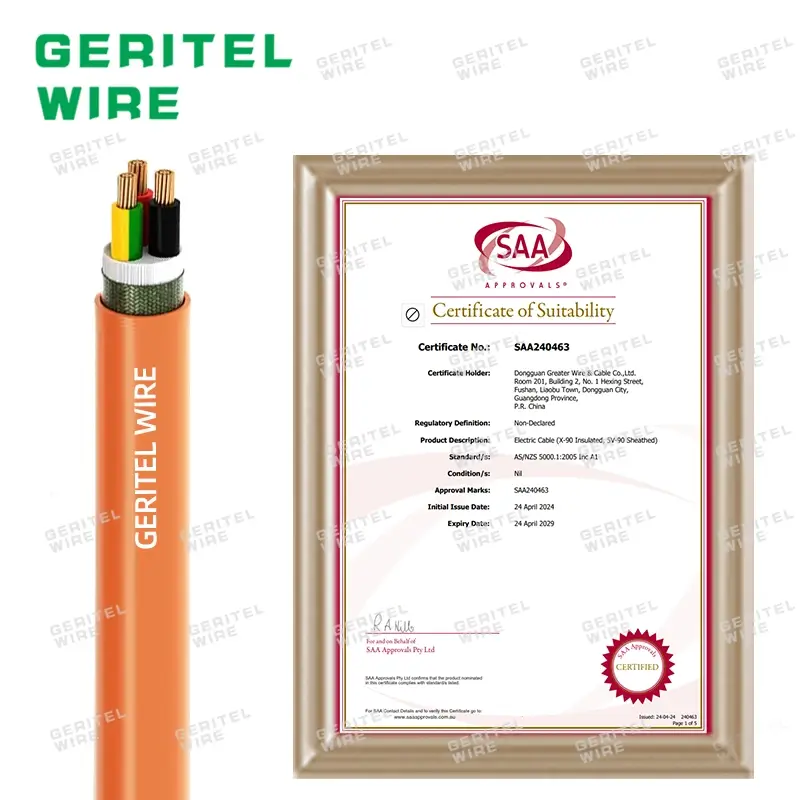
The client later told us that when selecting a supplier, their greatest concern wasn't price. It was whether "the certification documents would pass New Zealand customs inspection on the first attempt"—they had previously suffered a three-week project shutdown due to non-SAA-certified cables, a loss far exceeding the cable procurement cost itself.
The Core Pain Point: Why Cable Procurement in the Australasian Market is So "Treacherous"
WorkSafe New Zealand enforces an exceptionally stringent for imported cables. All products must comply with the AS/NZS 5000 series standards and hold valid SAA certification. Compounding the complexity, while Australia and New Zealand maintain mutual recognition of standards, the certification process involves multiple third-party tests including flame retardancy (IEC 60332-1), insulation resistance, and long-term aging assessments.
The QEA project's procurement manager initially approached three suppliers: a German firm (20-week delivery, exceeding the project window), a Southeast Asian trader (attractive pricing but unable to provide complete SAA technical documentation), and us. The client's technical team posed a pointed question: "If customs requests supplementary certification materials after the cables arrive, can you provide them within 48 hours?"
Behind this question lay their profound awareness of compliance risks. New Zealand's electrical product safety regulations require absolute consistency between product labeling, technical parameters, and certification documents—any discrepancy can result in entire shipments being detained at port. Our response: we provided not only original SAA certificates but also comprehensive third-party laboratory test reports, raw material traceability documentation, and a project-specific compliance declaration.
Product Deconstruction: Why Orange Circular Cable Became the Outdoor Choice
In the specific application at Queenstown's solar farm, 35mm² 3core Orange Circular Cable handles high-current flexible connections between energy storage inverters and battery banks. The client's initial design specified standard 25mm² cable, but our technical team recommended an upgrade based on local climate data.
Queenstown's elevation and geography present unique challenges: winter temperatures dropping to -10°C, summer UV radiation indices persistently at extreme levels, and mountainous terrain requiring cables to withstand mechanical stress. The 35mm² 3core specification's conductor cross-section not only provides higher current-carrying capacity margins (addressing peak charge/discharge demands from the storage system), its three-core structure (L+N+PE) simplifies earthing layout. More critically, the orange sheath employs 5V-90 grade PVC formulation with specialized UV stabilizers and low-temperature plasticizers, delivering 40% superior weathering resistance compared to standard black-sheath cables.
During installation, this choice yielded unexpected benefits. With cables exposed directly to outdoor conditions, no additional conduit protection was required, reducing installation labor by approximately 30%. The flexible conductor construction (Class 5 fine-stranded copper) enabled smoother routing within the cramped battery compartment spaces, minimizing joint stress.
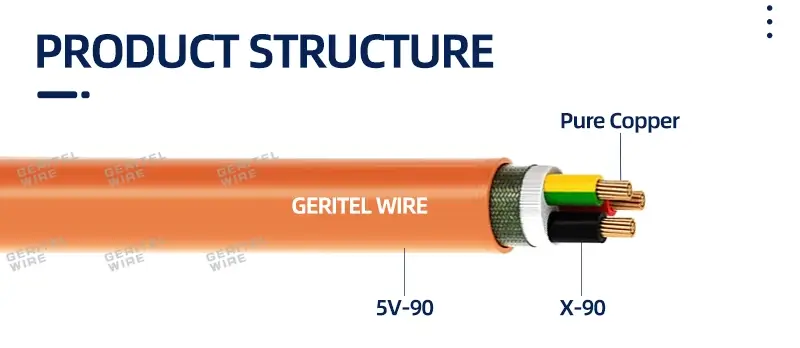
By contrast, 12/20kV Medium Voltage Cable selection emphasized mechanical protection. The 3-kilometer route from Frankton substation to the tourism district traversed partially undeveloped terrain. Our recommended 3x150mm² XLPE-insulated steel-wire-armored (SWA) cable not only met AS/NZS 1429.1 standards but also provided protection against rodent gnawing and rock abrasion through its galvanized steel tape armor. This aligned with the client's experience from previous Australian mining projects, where they had witnessed costly emergency repairs due to wildlife damage to unarmored cables.
The Hidden Advantage: Project Experience Matters More Than Products
During bidding, we highlighted a key differentiator: proven track record in Oceania projects. Our prior completion of the Sarakata Hydropower Station expansion in Vanuatu—involving supply of 20kV medium voltage cables, SWA-armored cables, and instrumentation cables—gave us deep understanding of Pacific island logistics challenges and climate adaptation requirements.
This experience translated into concrete project value:
Localization of Documentation: We knew the technical document formats preferred by the Electrical Power Engineers Association of New Zealand (EPECNZ). Our cable selection tables employed locally conventional parameter notation, allowing the client to submit directly to design institutes without secondary conversion.
Logistics Risk Anticipation: For Christchurch's Lyttleton Port receiving capabilities, we employed steel-wood structured cable drums rather than all-steel drums—meeting maritime strength requirements while facilitating standard forklift unloading by local contractors. Shock indicators and desiccant packs on each drum ensured quality integrity after up to 30 days of ocean transit.
Technical Support Responsiveness: During project execution, we maintained technical support windows covering New Zealand time zones. For on-site queries such as "Does the cable bending radius accommodate mountainous terrain?", we provided calculation verifications based on AS/NZS 3000 wiring standards within 24 hours.
The client later confirmed that these "soft capabilities" proved critical under tight schedules. When geological conditions necessitated last-minute length adjustments for a medium voltage cable section, we could rapidly insert a replenishment order during Week 6 of the production cycle without impacting overall delivery—flexibility stemming from our advance raw material price-locking and agile production scheduling.
Standards Certification: SAA Isn't Paper, It's a System
For the Australasian market, SAA certification's true value lies in its systematic quality assurance. In our production process, SAA compliance begins at raw material procurement:
• Copper Conductors: High-purity cathode copper (oxygen content <200ppm) ensures 100% IACS conductivity, meeting AS/NZS 1125 standards.
• Insulation Materials: XLPE insulation compounds from SAA-recognized suppliers, with each batch undergoing thermal elongation and cross-linking degree verification.
• Process Control: Extrusion operations implement online eccentricity monitoring to ensure insulation thickness uniformity; high-voltage spark testing provides 100% pinhole defect detection.
• Finished Product Verification: Every cable drum undergoes conductor resistance, withstand voltage, and sheath mechanical property testing, with data archived for traceability.
This systematic control extends SAA certification beyond final products to production consistency. When clients encounter "supplementary certification materials" requests from New Zealand customs, our rapid response capability stems from fully digitized traceability of all test data and quality records.
Project Resonance: From Single Procurement to Long-Term Partnership
The QEA project's successful delivery generated ripple effects exceeding expectations. The client's technical director noted in project closure that "the zero-failure operation of the cable system allowed us to reallocate maintenance budgets to other critical areas." Based on this collaboration, we have been enrolled in the preferred supplier list for the developer's other South Island tourism projects, with technical discussions underway regarding cable requirements for the 2025 Sarakata Hydropower Station Phase II expansion.
More strategically, the client began consulting us on Australian market opportunities. The high degree of electrical standard harmonization between Australia and New Zealand, with mutual SAA certification recognition, positions us to build regionalized service networks.
Implications for You: How to Select an Australasian Cable Supplier
If you are preparing electrical projects for New Zealand or Australia, three dimensions may deserve more consideration than price:
Completeness of Certification Documentation: Require suppliers to provide original SAA certificates, test reports, and declarations of conformity. Verify the specific product models and specification ranges covered by certification. Be wary of suppliers offering only "CE certification" while claiming suitability for Australasian markets.
Regional Project Experience: Inquire whether suppliers have actual delivery cases in Australasia or Pacific islands—this directly indicates their depth of understanding regarding local logistics, construction practices, and regulatory processes.
Supply Chain Resilience: Evaluate suppliers' raw material reserves and capacity flexibility. Particularly given current global copper price volatility and shipping uncertainties, can they commit to and fulfill short-lead-time deliveries?
Let Us Secure Your Next Project
Whether for tourism facility electrification in New Zealand, power upgrades in Australian mining districts, or renewable energy infrastructure in Pacific island nations, Dongguan GERITEL Electrical Co., Ltd. stands ready as your trusted partner through SAA-certified quality assurance, extensive Oceania project experience, and agile delivery capabilities.
We understand that every meter of cable carries your project's safety and efficiency. Choosing products compliant with AS/NZS standards is not merely a regulatory requirement—it is a long-term commitment to engineering quality.
Contact us today for your customized cable solution:
Dongguan GERITEL Electrical Co., Ltd.
• Tel/WhatsApp/WeChat: +86 135 1078 4550 / +86 136 6257 9592
• Email: manager01@greaterwire.com
• Website: www.greaterwire.com
We offer complimentary cable selection consultation, sample testing support, and on-site technical guidance. We look forward to partnering with you in advancing green energy transformation across Australasia.
 New Caledonia Submarine Communication Cable Project



 Building 2, No. 40 Luxi 2nd Road, Liaobu Town, Dongguan City, Guangdong Province, China