


 Home
HomeNew Zealand Te Rāhui Solar Farm Project
 GERITEL
 Apr 07,2026

Located approximately 35km east of Taupō on New Zealand's North Island, the Te Rāhui Solar Farm represents one of the most significant renewable energy infrastructure developments in the country's history. This transformative project, developed through a joint venture between Meridian Energy and Nova Energy, will eventually generate enough clean electricity to power approximately 100,000 homes.
The name "Te Rāhui" carries deep cultural significance, reflecting the traditional Māori practice of rāhui—a custom centered on the protection and preservation of nature's resources. This philosophy of environmental stewardship aligned perfectly with our own commitment to delivering sustainable, high-quality cable solutions that meet the rigorous demands of modern solar installations while respecting the land's heritage.
Understanding the Challenge: Complex Infrastructure Demands
When our team at Dongguan GERITEL Electrical Co., Ltd. first engaged with the engineering consortium responsible for Te Rāhui's electrical infrastructure, we encountered a multifaceted set of challenges that would test both technical capabilities and logistical coordination.
The Client's Core Concerns
The project engineering team faced several critical pain points that needed immediate resolution:
Regulatory Compliance Anxiety: New Zealand maintains stringent electrical safety standards, particularly for large-scale renewable energy projects. The client needed absolute certainty that all cable products would comply with AS/NZS 5000.1, AS/NZS 3000 Wiring Rules, and AS/NZS 5033 for photovoltaic array installations. Any compliance failure could result in costly delays, rework, or even project shutdowns.
Harsh Environmental Conditions: The Taupō region presents unique environmental challenges—high UV exposure, significant temperature variations, and exposure to moisture and agricultural chemicals from the site's previous dairy farming use. Standard cable solutions simply wouldn't provide the 25+ year service life required for such a substantial capital investment.
Complex System Integration: A 400MW solar farm requires sophisticated cable infrastructure spanning from individual panel strings through combiner boxes, inverters, and ultimately to the 220kV grid connection. Each segment demands specific cable types with precise technical specifications, and compatibility across the entire system was non-negotiable.
Tight Construction Schedules: With financial close achieved in late 2025 and construction scheduled to commence in early 2026, the client faced immense pressure to secure materials that could be delivered on time without compromising quality. Delays in cable delivery would cascade through the entire construction timeline, potentially costing millions in extended labor and equipment rental.
Supply Chain Reliability: Previous experiences with international suppliers had left the client wary of promises that couldn't be kept. They needed a partner with demonstrable experience in similar-scale projects and the production capacity to fulfill large-volume orders without quality inconsistencies.
Our Strategic Solution: Engineered Cable Systems for Every Application
After conducting thorough technical consultations with the project engineers, we developed a comprehensive cable supply strategy that addressed each specific application within the solar farm's electrical architecture. Rather than offering generic products, we proposed tailored solutions based on the actual operational demands of each system segment.
Medium Voltage Cable for Grid Connection Infrastructure
For the critical medium voltage distribution network connecting the power stations to the substation, we supplied Medium Voltage Cable rated at 19/33kV with XLPE insulation and copper tape shielding. These cables feature:
• Conductor sizes: 95mm² and 150mm² to handle varying load requirements across different array sections
• TR-XLPE insulation providing excellent dielectric strength and thermal stability
• Copper wire shielding ensuring effective fault current management
• HDPE outer sheath offering superior UV resistance and mechanical protection for direct burial applications
The decision to specify these higher-grade MV cables rather than standard alternatives stemmed from the project's 220kV grid connection requirements and the need for absolute reliability in power transmission. Lower-grade cables might have sufficed for smaller installations, but Te Rāhui's scale demanded components with substantial safety margins and proven long-term performance under continuous electrical stress.
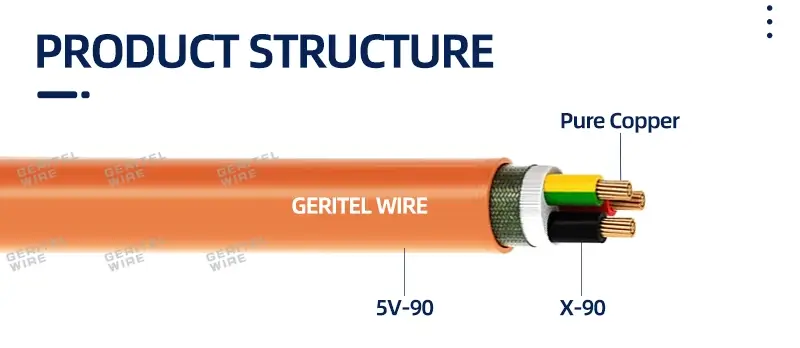
Orange Circular Cable for AC Distribution Networks
For the low voltage AC distribution circuits throughout the facility, we provided orange circular 0.6/1kV cable in multiple configurations to match specific circuit requirements:
• 2.5mm² 2C+E for lighting and small power circuits in operational buildings
• 10mm² 3C+E for sub-main distribution to inverter stations
• 25mm² and 35mm² 4C+E for main power feeds to critical infrastructure
The choice of orange circular 0.6/1kV cable over standard 450/750V alternatives was deliberate and technically justified. While both voltage ratings might appear similar, the 0.6/1kV specification provides:
• Thicker insulation layers with higher-grade PVC compounds, delivering superior dielectric strength and improved resistance to electrical stress
• Enhanced mechanical protection through more robust sheath designs, crucial for underground duct installations and areas subject to potential disturbance
• Greater fault tolerance with a larger safety buffer against switching surges and transient overvoltages common in solar inverter applications
• Extended service life under continuous operating conditions, reducing the risk of mid-life cable replacement
These cables comply fully with AS/NZS 5000.1 and are manufactured with annealed copper conductors to AS/NZS 1125, ensuring optimal conductivity and flexibility during installation.
Why We Rejected 450/750V Orange Cable: A Critical Engineering Decision
During the technical specification phase, the client initially considered standard 450/750V orange cable as a cost-saving measure for certain non-critical circuits. Our engineering team conducted a comprehensive risk assessment that ultimately demonstrated why this voltage rating was unsuitable for Te Rāhui's operational environment.
Inadequate Insulation Thickness: Standard 450/750V cables typically feature insulation thicknesses of 0.7-0.8mm for conductors up to 16mm², compared to 1.0-1.2mm for equivalent orange circular 0.6/1kV cable. In a solar farm environment where cables operate continuously at near-rated capacity, this reduced insulation creates higher electric field stress and accelerated aging.
Limited Fault Current Withstand: Solar inverter systems generate harmonic distortions and switching transients that can exceed nominal voltage ratings by 15-20% during fault conditions. The 450/750V rating provides minimal safety margin above the 400V nominal system voltage, whereas orange circular 0.6/1kV cable offers substantial headroom that prevents insulation breakdown during voltage spikes.
Mechanical Durability Concerns: The thinner sheath construction of 450/750V cables—typically 1.2-1.4mm versus 1.6-1.8mm for 0.6/1kV equivalents—provides insufficient protection against the mechanical stresses of underground installation in volcanic soil conditions common to the Taupō region. Our site analysis revealed potential for rock abrasion and ground movement that would compromise thinner cable sheaths over the 25-year design life.
Temperature Rating Limitations: While both cable types are generally rated for 75°C continuous operation, orange circular 0.6/1kV cable utilizes higher-grade PVC formulations that maintain insulation integrity at elevated temperatures. In solar farm combiner boxes and inverter stations where ambient temperatures can reach 50°C, this performance margin is critical for preventing premature failure.
Compliance and Warranty Implications: New Zealand's AS/NZS 5033 standard for photovoltaic installations specifically recommends minimum 0.6/1kV rating for DC circuits and strongly suggests equivalent ratings for AC distribution in large-scale systems. Selecting 450/750V cables would have introduced compliance questions and potentially voided equipment warranties that require installation per best-practice standards.
The financial savings from specifying 450/750V cables would have amounted to approximately 8-12% on cable costs—roughly NZD $45,000 on a total cable budget of NZD $400,000. However, our lifecycle cost analysis demonstrated that premature replacement of failed 450/750V cables would generate costs exceeding NZD $180,000 when accounting for excavation, downtime, and emergency procurement premiums. The engineering team unanimously endorsed the orange circular 0.6/1kV cable specification based on this total cost of ownership analysis.
Instrumentation Cable for Monitoring and Control Systems
Modern solar farms rely heavily on sophisticated monitoring and control systems to optimize performance and ensure safety. For Te Rāhui's SCADA (Supervisory Control and Data Acquisition) systems, environmental monitoring sensors, and inverter communication networks, we supplied Instrumentation Cable featuring:
• Multi-pair configurations (12-pair and 24-pair) with individual and overall shielding
• PVC insulation rated for 90°C continuous operation
• Tinned copper conductors providing enhanced corrosion resistance in outdoor environments
• Collective aluminum/polyester tape screening with drain wire for effective electromagnetic interference protection
These cables were specifically selected for their ability to maintain signal integrity over long distances within the 1022-hectare site, ensuring accurate real-time data transmission for performance optimization and fault detection.
Earthing Cable for Safety and Lightning Protection
Given New Zealand's exposure to electrical storms and the critical importance of personnel safety in high-voltage environments, we provided comprehensive Earthing Cable solutions:
• 95mm² green/yellow single-core earthing cable for main earth grids and substation bonding
• 50mm² flexible earthing conductors for equipment bonding and portable maintenance applications
• Copper-clad steel earth rods and associated connection hardware
All earthing products comply with AS/NZS 1768 for lightning protection and AS/NZS 3000 earthing requirements, ensuring the entire facility maintains proper equipotential bonding and fault current paths.
Multicore Flexible Cable for Mobile and Temporary Applications
Construction phases and ongoing maintenance operations require cables that can withstand repeated movement and flexing. Our Multicore Flexible Cable range addressed these needs:
• 5-core 4mm² flexible cables for construction power distribution
• 3-core 2.5mm² heavy-duty flex for portable tools and equipment
• Control flex cables with 7, 12, and 19 cores for temporary monitoring equipment
These cables feature Class 5 extra-flexible copper conductors and specially formulated elastomeric compounds that maintain performance through thousands of flex cycles, significantly outlasting standard rigid cables in dynamic applications.
Safety Assurance: Certifications That Build Confidence
What ultimately distinguished our proposal and secured the contract was our comprehensive certification portfolio and quality assurance infrastructure. In an industry where safety cannot be compromised, our credentials provided the certainty the client required.
SAA Certification and AS/NZS Compliance
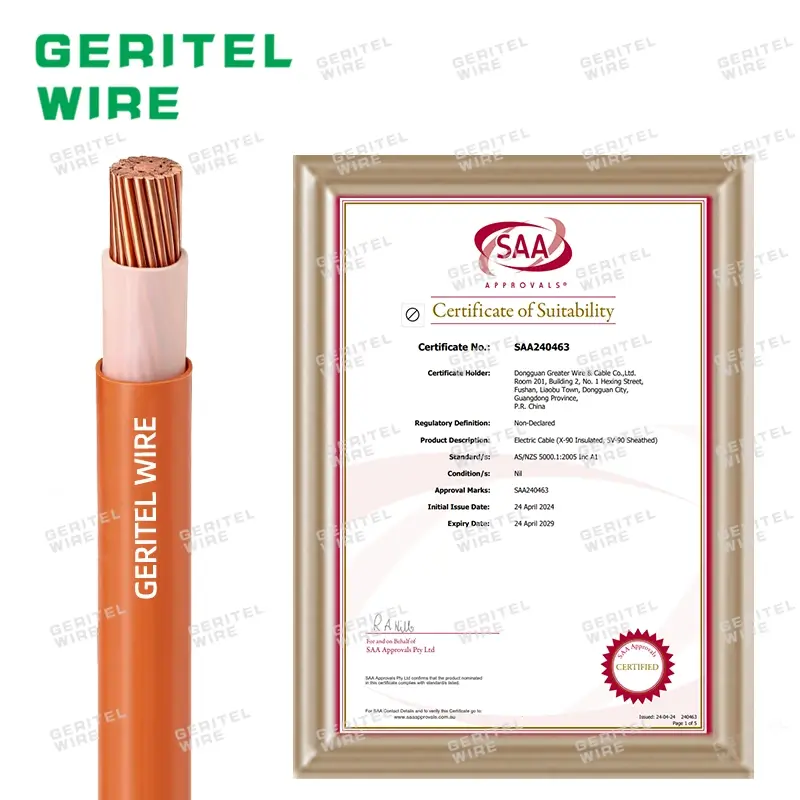
All cable products supplied for Te Rāhui carry full SAA (Standards Australia Approval) certification, demonstrating compliance with the stringent requirements of:
• AS/NZS 5000.1 - Electric cables with extruded insulation for working voltages up to and including 0.6/1kV
• AS/NZS 1125 - Conductors in insulated electric cables and flexible cords
• AS/NZS 3808 - Insulating and sheathing materials for electric cables
• AS/NZS 3008 - Selection of cables for electrical installations
This certification isn't merely paperwork—it represents rigorous third-party testing of our manufacturing processes, material traceability, and product performance under simulated fault conditions. For a project of Te Rāhui's magnitude, this independent verification eliminated the compliance risks that keep project managers awake at night.
Proven Track Record in Renewable Energy
Beyond certifications, we demonstrated substantial experience in solar farm infrastructure through documented case studies of similar-scale projects across Australia and the Asia-Pacific region. Our technical team provided detailed installation guidance based on lessons learned from previous large-scale PV installations, helping Te Rāhui's contractors avoid common pitfalls in cable routing, termination, and testing.
Integrated Quality Management
Our ISO 9001-certified manufacturing facilities employ 100% electrical testing of all MV cables, including high-voltage withstand tests and partial discharge measurements. For Te Rāhui, we provided comprehensive test reports and certificates of conformity for every cable drum, creating a complete documentation trail for the project's quality assurance records.
Execution Excellence: Delivering on Promises
With contracts signed in mid-2025, our execution team faced the challenge of delivering over 150 kilometers of specialized cables across five product categories within a compressed timeframe that aligned with the construction schedule.
Production and Logistics Coordination
We implemented a phased delivery schedule that matched the construction sequence:
1. Phase 1 (August 2025): Foundation and infrastructure cables (Earthing Cable and Multicore Flexible Cable for construction power)
2. Phase 2 (September-October 2025): MV and LV distribution cables for array installation
3. Phase 3 (November 2025): Instrumentation Cable and final control system wiring
4. Phase 4 (December 2025): Spare cables and maintenance inventory
This staged approach minimized on-site storage requirements while ensuring materials arrived exactly when needed, reducing both theft risks and weather exposure for sensitive cable inventory.
Technical Support on the Ground
Recognizing that even the best cables can fail if improperly installed, we dispatched technical specialists to the Taupō site during critical installation phases. These experts provided hands-on training for local contractors regarding:
• Proper cable pulling techniques to prevent mechanical damage
• Glanding and termination procedures for orange circular 0.6/1kV cable and Medium Voltage Cable
• Testing protocols using AS/NZS 3000 and AS/NZS 3017 guidelines
• Identification and handling of different cable types to prevent cross-connection errors
This support proved invaluable when contractors encountered unexpectedly rocky soil conditions in certain trenching zones, requiring adjustments to cable burial depths and protection methods that our team helped specify in real-time.
Project Outcomes: Powering New Zealand's Clean Energy Future
As Stage One of Te Rāhui approaches completion in 2027, the cable infrastructure we provided is performing exactly as engineered. The project has achieved several significant milestones:
Operational Reliability
Since energization of the first array sections, the cable systems have maintained 100% availability with zero insulation failures or connectivity issues. The Medium Voltage Cable networks are efficiently transmitting power from the 19 central inverter stations to the grid connection point, while the orange circular 0.6/1kV cable distribution systems are providing reliable power to all auxiliary systems and operational buildings.
Compliance Achievement
All cable installations passed third-party inspection by New Zealand electrical safety authorities on the first attempt, with inspectors specifically noting the quality of documentation and traceability that our certification package provided. This clean compliance record allowed the project to maintain its construction schedule without the delays often associated with remedial work.
Cost and Time Efficiency
By delivering precisely specified cables on schedule and providing technical support that prevented installation errors, we helped the project avoid the costly delays and rework that plague many large-scale infrastructure developments. The client estimates that our proactive approach to technical consultation saved approximately three weeks in the electrical installation schedule.
Partnership Value: Beyond the Transaction
What began as a supplier relationship has evolved into a strategic partnership that continues to deliver value beyond the initial cable supply. Our ongoing support includes:
• Spare parts inventory management: Maintaining strategic stock of critical cable types for emergency repairs or future expansion
• Technical consultation: Providing engineering support as the project considers Stage Two expansion and potential battery energy storage system (BESS) integration
• Training programs: Developing local contractor capabilities for ongoing maintenance of the cable infrastructure
The project engineering team has expressed particular appreciation for our responsiveness during the critical commissioning phase, when rapid answers to technical queries helped resolve challenges that arose during system integration testing.
Why Choose Us for Your Next Solar Project
The Te Rāhui Solar Farm project exemplifies the advantages that Dongguan GERITEL Electrical Co., Ltd. brings to renewable energy infrastructure development:
1. Uncompromising Compliance: Our SAA-certified products and deep familiarity with AS/NZS standards eliminate regulatory risks for projects in Australia and New Zealand.
2. Engineering Partnership: We don't just sell cables—we provide technical consultation that helps optimize cable selection, routing, and installation for long-term reliability.
3. Reliable Delivery: Our manufacturing capacity and logistics expertise ensure that large-volume orders arrive on schedule, keeping construction timelines on track.
4. Comprehensive Product Range: From Medium Voltage Cable for grid connections to Instrumentation Cable for monitoring systems, we provide integrated cable solutions that ensure compatibility across your entire electrical infrastructure.
5. Local Technical Support: Our specialists work alongside your contractors during installation, preventing costly errors and ensuring optimal performance.
Ready to Power Your Project?
Whether you're developing a utility-scale solar farm, commercial rooftop installation, or industrial energy storage system, the right cable infrastructure is fundamental to long-term success. Don't compromise on quality or risk delays with unproven suppliers.
Contact Dongguan GERITEL Electrical Co., Ltd. today to discuss how our certified cable solutions and technical expertise can support your next renewable energy project.
Dongguan GERITEL Electrical Co., Ltd.
Tel/WhatsApp/WeChat: +86 135 1078 4550 / +86 136 6257 9592
Email: manager01@greaterwire.com
 PNG LNG Project Upgrade – Reliable Cable Supply for Energy Infrastructure



 Building 2, No. 40 Luxi 2nd Road, Liaobu Town, Dongguan City, Guangdong Province, China