


 Home
HomeGLP Germany Logistics Rooftop Solar Portfolio (23MW)
 GERITEL
 Apr 21,2026

I. Project Origins: Where Logistics Real Estate Meets Distributed Solar
In early 2025, the clean energy division of GLP—a global leader in logistics real estate—launched a nationwide rooftop solar initiative across ten of its German logistics parks. The portfolio totaled 23 MW of distributed generation capacity, with the first site in Mönchengladbach (3.8 MW) leading the rollout, followed by Mannheim, Frankfurt West, Schifferstadt, and six additional locations. Unlike a centralized ground-mount installation, this project followed a multi-site, standardized, phased-delivery model, with Energy Partners GmbH serving as the EPC contractor responsible for end-to-end execution.
Germany's solar market has long ranked among Europe's most mature, with distributed generation representing a significantly higher share than in most countries. Commercial and industrial (C&I) projects typically fall within the 100 kW to 5 MW range, characterized by rapid decision cycles, acute price sensitivity, and stringent certification requirements. For GLP, the underlying business model was not subsidy-dependent; rather, rooftop solar served as a tenant value proposition through Power Purchase Agreements (PPAs). The moment a site began generating power, tenants started saving on electricity costs and GLP strengthened its lease renewals—making delivery timelines a critical performance metric for the EPC.
II. Client Concerns: Risk Management Before Cost Optimization
During pre-project technical discussions, the EPC team articulated four fundamental concerns rooted in Germany's unique regulatory environment and long-term liability framework.
Certification Authenticity. German regulations explicitly prohibit the use of ordinary power cables on the DC side of photovoltaic systems. 1500V installations impose statutory thresholds for insulation withstand voltage, UV resistance, and weathering performance. Yet the market is saturated with suppliers claiming certifications they cannot substantiate with traceable registration numbers. Discovery of invalid credentials during grid-connection inspection or subsequent audit would trigger loss of interconnection eligibility, full write-off of sunk costs, and contractual penalty exposure.
Fire Safety Compliance. Logistics warehouses fall under commercial building classification, where German fire codes enforce extremely strict smoke toxicity standards for rooftop materials. Halogen-containing compounds release toxic gases when burned, endangering human life and exposing property owners to massive liability claims and operational shutdowns. Low smoke zero halogen (LSZH) properties in this context are not a differentiating feature but a mandatory market entry condition.
Supply Chain Stability. Ten sites spread across different cities, each with staggered construction windows, required cables to arrive in precisely sequenced batches. Delayed delivery would leave construction crews idle with accumulating labor and equipment rental costs; premature arrival would strain on-site storage capacity and risk moisture degradation from outdoor exposure. The EPC needed supply chain synchronization calibrated to their construction cadence.
Lifecycle Reliability. German solar projects are designed for 25-year operational life, after which cable replacement within rooftop installations becomes prohibitively expensive. Insulation aging, sheath cracking, or terminal oxidation appearing within the first several years would generate repair costs far exceeding initial procurement differentials—and as the EPC held the prime contract, cable failures became their financial responsibility.
III. Technical Solution Development: From Roof Survey to Specification Lock
Upon receiving the inquiry, our technical team conducted two detailed video conferences with the EPC, systematically reviewing each site's electrical topology, module layout, inverter positioning, and switchgear distances. Given the German C&I market's profile—limited individual project scale but high volume, compressed decision cycles, and acute price sensitivity—the cable solution was architected around standardization, replicability, and single-design-multiple-deployment principles.
When discussing string interconnection methodologies, the EPC's technical lead raised a specific concern about snowmelt corrosion on conductive materials. German winters bring frequent rooftop snow accumulation, and residual salts from de-icing agents create aggressive electrochemical corrosion environments. We addressed this by presenting tin-plated copper conductor technology: the tin layer forms a dense oxide film on the copper surface that significantly retards corrosion progression in humid and saline atmospheres, extending the contact resistance degradation timeline by three to five times compared to bare copper under identical conditions. This characteristic carries particular relevance for German rooftops subject to alternating snowmelt chemical exposure and summer precipitation.
Regarding wiring distances from combiner boxes to inverters, we recommended 4 mm², 6 mm², and 10 mm² cross-sections to cover varying circuit lengths, maintaining line voltage drop below 2% under 1500V system voltage. This approach preserved generation efficiency while avoiding unnecessary conductor oversizing that would inflate material costs without proportional benefit. Collectively, these three specifications accounted for over 70% of total cable volume across the portfolio, forming the backbone of the supply program.
IV. Certification Verification: From Sample Photos to Database Queries
In the second technical session, the EPC's compliance officer joined with a direct requirement: cable markings must clearly indicate the current harmonized standard, not legacy nomenclature. This request reflected practical German inspection experience—the current standard mandates thicker insulation walls, enhanced mechanical protection, and compulsory LSZH construction. Inspectors encountering current-standard markings typically grant immediate acceptance, whereas legacy designations may trigger supplementary test report requests that compress already-tight construction schedules.
We presented sample photographs showing black outer sheaths with laser-etched markings clearly identifying the standard designation, certification symbols, and rated parameters. During material discussion, we detailed the technical meaning of LSZH sheathing solar cable: under fire conditions, combustion produces low smoke density with zero halogenated hydrogen gas release, fully aligning with German commercial building fire codes and GLP's corporate commitments to tenant safety.
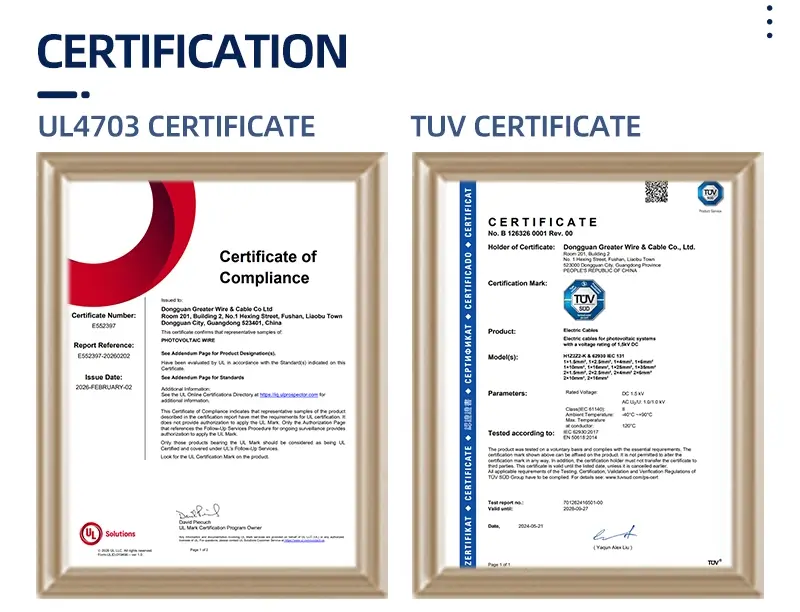
The pivotal moment followed. The compliance officer requested certification numbers for database verification. We provided TÜV Certificate No. B 126326 0001 Rev.00 and invited immediate verification through TÜV's official registry. Confirmation came within minutes—in the German market, verifiable certification and unsubstantiated claims occupy fundamentally different risk categories. We additionally furnished UL4703 File No. E552397, demonstrating North American market access that would allow the EPC to leverage our supplier relationship for future U.S. projects without sourcing redevelopment.
V. AC Side and Safety Grounding: Systematic Cable Integration
For the AC output circuit from inverters to low-voltage switchgear—where current carrying capacity and voltage class requirements exceed DC cable capabilities—we recommended 0.6/1kV XLPE insulated power cables, European equivalents NYY / N2XY, in 70 mm², 95 mm², and 120 mm² cross-sections. Given German rooftop project scale limitations, this sizing achieved optimal balance between ampacity and voltage drop without oversizing driven by excessive safety margins.
Compared to conventional PVC-insulated NYY, N2XY employs XLPE cross-linked polyethylene insulation, elevating continuous operating temperature from 70°C to 90°C and short-circuit withstand from 160°C to 250°C. This enhanced thermal profile provides superior dimensional stability under summer rooftop temperature extremes, reducing long-term maintenance frequency and associated lifecycle costs.
For grounding systems, each site received 16 mm² to 50 mm² yellow-green dedicated grounding cables. German regulations classify grounding continuity inspection as mandatory acceptance criteria, with inspectors verifying connection integrity and cross-section compliance at every point. We have witnessed numerous projects where cost-saving substitutions with ordinary conductors triggered wholesale rework orders; our approach mandated dedicated grounding cable from the initial design phase, with clear color identification and cross-sections calculated precisely per circuit fault current requirements.
VI. Competitive Positioning: Why Risk Scoring Outweighed Price Advantage
During supplier selection, our quotation was not the lowest submitted, yet our composite risk score significantly outperformed competitors based on five structural advantages:
Traceable Certification. We provided not scanned copies but officially queryable registration numbers. In Germany's transparent market environment, fraudulent certification results in permanent supplier blacklisting and exposes the EPC to project failure liability.
Multi-Standard Coverage. Beyond TÜV and EN 50618, our UL4703 (E552397) certification endowed the EPC's supplier list with cross-market scalability, eliminating sourcing redevelopment needs when entering North American or other UL-jurisdiction markets.
European Project Track Record. We furnished complete delivery documentation from prior comparable-scale projects, including batch consistency data, German jobsite implementation feedback, and local inspection authority acceptance certificates—materials carrying substantially more credibility than marketing collateral.
Batch Stability Commitment. Addressing the ten-site requirement for electrical parameter uniformity, we committed to ±3% batch-to-batch variation control for conductor resistance, insulation thickness, and sheath mechanical properties. This ensured that construction crews across different cities received effectively identical products, eliminating process adjustments necessitated by specification drift.
LSZH as Baseline Configuration. While some suppliers position low smoke zero halogen as a premium upgrade with surcharge pricing, our product incorporates halogen-free construction from design inception, satisfying German CPR Eca/Dca classification requirements without supplemental engineering or additional cost.
VII. Delivery Execution: Supply Chain Coordination Across Ten Cities
Germany's rooftop solar market reached an estimated $4.3 billion valuation in 2025, with C&I distributed generation as the primary growth driver. Logistics real estate's adoption of solar-as-a-service through PPA structures has become an established industry pattern.
Our delivery execution precisely matched the EPC's construction windows. Q1 2025: Mönchengladbach, Mannheim, and Frankfurt West launched simultaneously, with cables arriving in three dedicated truckloads direct to site, each accompanied by German-language compliance documentation, batch test reports, and material traceability certificates. Q2–Q3: Schifferstadt and the remaining six sites received sequenced deliveries, with production capacity locked six weeks ahead to circumvent summer peak-season logistics congestion. Q4: Final sites achieved grid connection, documentation archived, and GLP's ESG audit and tenant PPA activation supported.
Throughout the full project cycle: zero batch quality disputes, zero delivery delays, zero inspector rejections.
VIII. Project Outcomes: Quantifiable Delivery Value
By year-end 2025, all ten GLP logistics park rooftop systems were operational, collectively generating 23 MW delivered to tenants through Power Purchase Agreements. For the EPC, the core deliverable was not numerical capacity but process controllability: zero cable-related installation rework, first-pass TÜV inspection acceptance, 25-year design life supported by standards documentation, on-schedule tenant PPA activation, and zero lease commitment disruptions attributable to electrical inspection delays.
IX. Market Insight: The German Logic of Compliance Before Cost
The fundamental rule of Germany's solar market is straightforward: compliance is prerequisite, pricing is secondary. The DC side requires photovoltaic-specific cable meeting current harmonized standards; certification numbers must be officially verifiable; LSZH construction is mandatory for commercial buildings. The experience across ten sites demonstrates that correct cable selection eliminates half the project's risk exposure.
Dongguan GERITEL Electrical Co., Ltd. specializes in certified cable and power distribution solutions for global photovoltaic projects.
Business Inquiries:
Tel/WhatsApp/WeChat: +86 135 1078 4550 / +86 136 6257 9592
Email: manager01@greaterwire.com
Company: Dongguan GERITEL Electrical Co., Ltd.
 Francisco Pizarro 590MW Solar Plant, Spain – Iberdrola Utility-Scale Photovoltaic Project



 Building 2, No. 40 Luxi 2nd Road, Liaobu Town, Dongguan City, Guangdong Province, China