


 Home
HomeFiji Labasa Airport Runway Strengthening & Electrical Upgrade
 GERITEL
 Apr 09,2026

One Monday morning in January 2023, an urgent email landed in the inbox of Dongguan GERITEL Electrical. The sender was a procurement manager from a Fijian engineering contractor. The subject line read: "Labasa Airport Project — We Need Cables That Can Survive 'Hell Mode.' Do You Have SAA Certification?"
Behind this email lay a classic South Pacific infrastructure dilemma. Labasa Airport, the northern aviation hub on Fiji's second-largest island Vanua Levu, faced a complete electrical system overhaul. Built in the 1960s, the runway lighting and terminal power systems had aged to the point where pilots were getting nervous. Worse, the project had to finish during the 2023 dry season (May-October) — once the rainy season hit, construction would shut down for six months.
The client's core challenge was clear: They didn't need ordinary cables. They needed "special forces" capable of withstanding tropical marine climates, active seismic zones, salt spray corrosion, while meeting stringent Australian-New Zealand safety standards. And the timeline? Half that of a typical project.
Why Ordinary Cables Fail in Fiji
To understand this project's complexity, let's conduct a thought experiment. Imagine placing a standard PVC cable in this environment:
• Temperature: Daily average 30°C, humidity 90%, feeling like a sauna
• Salt spray: Just 2 kilometers from the coastline, airborne salt particles act as "chronic poison" for metal components
• Vibration: Located on the Pacific Ring of Fire, minor tremors are routine, major earthquakes always possible
• Biological attacks: Tropical termites and rodents have surprising "appetites" for cable sheaths
What happens to ordinary cables here? PVC sheaths age rapidly and become brittle. Copper conductors corrode in salt spray. Seismic activity or construction machinery causes hidden damage. And if fire breaks out, PVC cables release massive toxic black smoke — a lethal hazard in crowded airport terminals with limited evacuation routes.
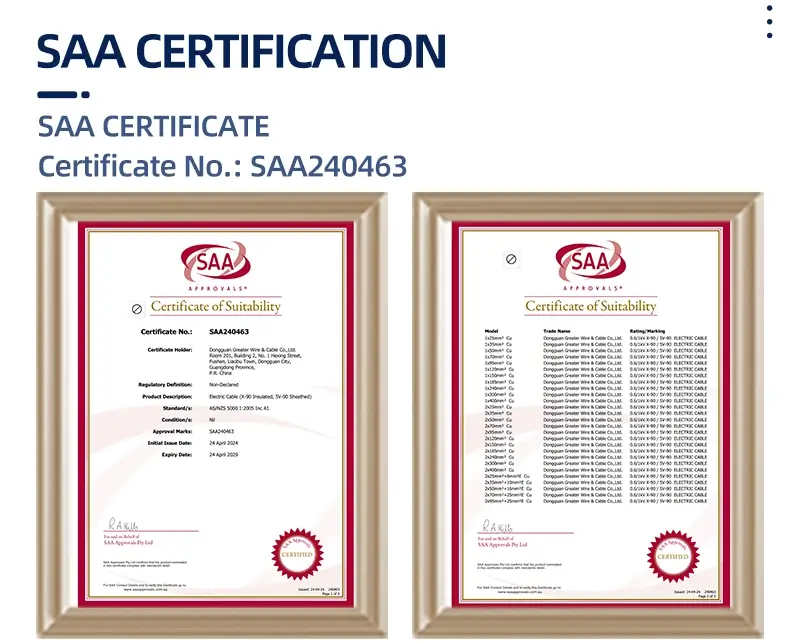
This is why the client specifically demanded SAA Certification (Standards Australia Approval). This isn't just a piece of paper; it's a passport into Australian, New Zealand, and South Pacific Commonwealth markets. SAA certification means products have passed rigorous AS/NZS standard testing for electrical safety, mechanical strength, weather resistance, and fire performance.
Many suppliers stumble here. Their CE or generic ISO certificates get rejected at Fijian customs. Our SAA certificate numbers can be verified in real-time on Australian electrical safety regulator websites — eliminating compliance risks for our clients.
The Cable Quartet — Each Agent Has Unique Skills
After three rounds of technical discussions, we designed a "quartet" cable solution for Labasa Airport. Each cable acts like a specialized agent, playing an irreplaceable role in its specific position.
Agent One: Orange Circular Cable — The Main Power Artery
Imagine the airport's electrical system as the human circulatory system. Orange Circular Cable is the aorta. We supplied multiple specifications including 1×95mm², 3×50mm²+1×25mm², and 4×25mm², powering high-demand equipment like terminal air conditioning, runway lighting transformers, and pump stations.
Why orange? It's not just aesthetics. On complex construction sites, orange sheaths allow workers to identify main power circuits from 10 meters away, preventing misoperation. More critically, its XLPE (cross-linked polyethylene) insulation raises heat resistance from 70°C to 90°C, reduces dielectric loss by 30%, and extends service life by 50% in Fiji's hot, humid conditions.
The client initially considered cheaper PVC alternatives. We showed them data: at a Samoan airport with similar climate, PVC cables showed 17% insulation aging failures within 5 years. At a Papua New Guinea project using XLPE cables, the 10-year failure rate was just 3%. The numbers convinced them.
Agent Two: TPS Cable — The Invisible Ninja Inside Buildings
If Orange Circular Cable is the aorta, TPS Cable represents the capillaries. Our specifications of 2×2.5mm², 3×1.5mm², and 2×4mm²+1×2.5mm² handle terminal internal power distribution, control circuits, and low-voltage systems.
Its special weapon is the flat structure. Traditional round cables consume excessive space in narrow ceiling cavities and wall conduits, and resist bending. TPS's flat profile saves approximately 30% installation space and flexes around building structures. We specially provided white sheath versions — imagine looking up at an airport ceiling and seeing no ugly black cables disrupting the aesthetic. That's the value of details.
Agent Three: SWA Cable — The Armored Knight for Outdoor Environments
Runway perimeter and underground main power lines face triple threats: mechanical damage, rodent attacks, and soil corrosion. Our SWA Cable, specification 4×35mm²+1×16mm², is the "armored knight" born for this mission.
Its galvanized steel wire armor withstands side pressures exceeding 2000N — equivalent to an adult cow standing on the cable. At Labasa, one section needed to pass beneath the runway itself, facing risks from construction machinery weight and soil settlement. SWA Cable's steel tape acts like chain mail, ensuring safety even in direct burial applications.
The client's project engineer later told us that in South Pacific island projects, coconut tree root growth crushing cables and construction machinery accidental damage are common nightmares. SWA Cable was the only solution they found capable of addressing both threats simultaneously.
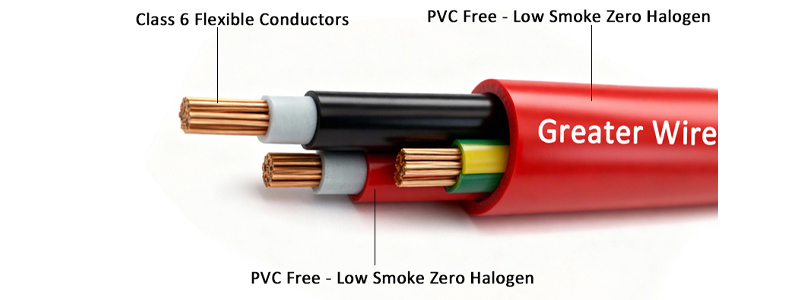
Agent Four: 2.5 mm² 3core LSZH Fire Rated Cable — The Final Lifeline for Safety
Now let's discuss this project's most critical and technically sophisticated player — 2.5 mm² 3core LSZH Fire Rated Cable.
Why so important? Because airport fire protection systems, emergency lighting, and fire alarm circuits are the "lifelines" ensuring evacuation during fires. Ordinary cables release massive toxic black smoke and corrosive halogen gases (like hydrogen chloride) when burning. These substances can incapacitate people within minutes and damage critical electronic equipment.
2.5 mm² 3core LSZH Fire Rated Cable uses LSZH (Low Smoke Zero Halogen) materials. When exposed to 750°C flames, it maintains circuit integrity for 90 minutes while reducing smoke density by over 60% compared to PVC cables, releasing no toxic gases.
Here's a real comparison: A 2019 airport fire investigation showed that in areas using PVC cables, smoke obscured evacuation signs within 90 seconds. In areas with LSZH cables, visibility remained adequate for 15 minutes. In crowded airport terminals like Labasa with complex evacuation routes, 2.5 mm² 3core LSZH Fire Rated Cable isn't just compliance — it's the final guarantee of life safety.
The client initially hesitated at LSZH cable costs — roughly 15-20% more expensive than traditional options. We explained "total lifecycle cost": while initial investment is slightly higher, it avoids fire-related equipment corrosion damage, reduces post-fire cleanup time (PVC fires require professional removal of corrosive residues, while LSZH residue is non-toxic and easily cleaned), and lowers liability risks. Ultimately, the client adopted 2.5 mm² 3core LSZH Fire Rated Cable comprehensively across all critical safety circuits.
Our Three Winning Cards — Certification, Experience, and Speed
Among multiple competing suppliers, GERITEL won for three key reasons:
Winning Card One: The Real Value of SAA Certification
Many suppliers mistake SAA for just a certificate. It's actually a complete compliance system. Our cables pass not only AS/NZS 5000.1 (power cables), AS/NZS 5000.2 (control cables), and AS/NZS 3013 (fire-resistant cables) testing, but also meet Fiji's mandatory adoption of Australian-New Zealand standards as a Commonwealth nation.
More importantly, our SAA certificates cover the entire South Pacific mutual recognition system. This means clients don't need repeated certification for New Zealand or Australian follow-up projects — this "one certification, multiple countries" convenience represents long-term value clients appreciate.
Winning Card Two: Regional Wisdom from South Pacific Projects
GERITEL isn't new to the South Pacific "battlefield." We've successfully delivered the Sarakata Hydropower Expansion Project in Vanuatu (primarily requiring medium voltage cables, SWA armored cables, instrumentation cables, and elastomer cables for power transmission, substation upgrade, and hydropower equipment connections), the Port Moresby Port Electrification Project in Papua New Guinea, and others.
This experience gives us deep understanding of regional specifics: maritime logistics complexity (considering container moisture protection in tropical seas), customs documentation requirements (SAA certificates need specific formatting), and local contractor preferences (for Australian-standard joints). When clients mentioned Labasa port customs delay risks, we prepared duplicate document packages — one for Fijian customs requirements, one backup for unexpected inspections. This "predictive service" impressed the client.
Winning Card Three: Flexible Delivery at Extreme Speed
Airport projects have tight schedules, with some cable requirements only finalized mid-construction. GERITEL's flexible production lines at our Dongguan facility enable 45-day standard delivery and 15-day emergency expedited delivery dual-track service.
In this project, when the client suddenly increased an order for 2.5 mm² 3core LSZH Fire Rated Cable for a new fire pump room, we completed production and air-shipped to Fiji within 18 days. The client later feedback that this response speed was "faster than their local suppliers" — in South Pacific island nations, local suppliers often need 8-12 weeks for import cycles.
Act Four: Thrilling Moments at the Construction Site
Even the best cables fail if improperly installed. GERITEL's technical team provided detailed cable installation manuals before shipment, emphasizing three critical points for South Pacific high-temperature environments:
First, minimum bending radius. Armored cables need 15× outer diameter bending radius; non-armored need 6×. Early in the Labasa project, a local electrician bent SWA Cable into a "hairpin turn" to save effort. Our remote video guidance corrected this operation promptly, preventing long-term damage from steel tape deformation.
Second, UV protection. Although our cable sheaths contain UV stabilizers, prolonged exposure in Fiji's intense sunlight still accelerates aging. We recommended installing sunshades on cable trays — this suggestion was later written into the project's maintenance manual.
Third, joint moisture protection. In high-humidity tropical environments, cable joints are high-failure zones. We provided special heat-shrink sleeves plus waterproof putty dual-protection solutions, and trained local electricians in this technique. During project acceptance, all joint insulation resistance tests passed on the first attempt.
When Planes Land Safely, Cables Work in Silence
In October 2023, the Labasa Airport project passed Fiji Civil Aviation Authority acceptance. The new power system achieved 99.98% availability, with runway lighting response time reduced to 0.3 seconds — meeting ICAO Category I precision approach standards.
At the project summary meeting, the client noted that what reassured them most wasn't the data, but "knowing these cables work silently underground, but won't fail at any critical moment." The deployment of 2.5 mm² 3core LSZH Fire Rated Cable earned the terminal fire protection system an "Excellence in Safety Rating" from Fiji's Fire Service — a first for airports in the region.
From a cost perspective, although GERITEL's quotation was 8-12% higher than some uncertified suppliers, the high-quality cables' 25-year design life (far exceeding the industry average of 15 years) and extremely low failure rate will save the client approximately USD 400,000 in maintenance and replacement costs over the next decade. That's true "cost-effectiveness."
Insights for You: Three "Soul-Searching Questions" When Choosing Cable Suppliers
If you're managing an overseas infrastructure project — whether airport, hospital, hotel, or energy facility — ask these three questions when selecting cable suppliers:
1. "Will your certification clear customs in the destination country?" Don't be fooled by vague "international certification" claims. Ask for specific certificate numbers and verification websites. SAA certification is a hard threshold in South Pacific and some Southeast Asian Commonwealth nations.
2. "Do you have project experience in similar climates and industries?" Cables aren't commodity products. Tropical islands, high-altitude regions, and desert environments have completely different selection logics. Regional experience means the ability to anticipate problems.
3. "If project requirements change mid-stream, how fast can you respond?" Infrastructure projects have high uncertainty. A supplier's flexible production capacity often matters more than initial pricing.
Closing Words: Let Us Safeguard Your Next Project
The Labasa Airport story is just one of GERITEL's many cases in the South Pacific. From Vanuatu's hydropower stations to Fiji's airports, from Papua New Guinea's ports to Solomon Islands' hospitals, we've helped clients resolve electrical infrastructure challenges using SAA-certified authoritative qualifications, deep regional project experience, and agile reliable delivery capabilities.
Whether your project faces salt spray on tropical islands or extreme temperature swings at high altitudes, we provide customized AS/NZS-standard cable solutions.
Ready to start the conversation?
Dongguan GERITEL Electrical Co., Ltd.
Tel/WhatsApp/WeChat: +86 135 1078 4550 / +86 136 6257 9592
Email: manager01@greaterwire.com
 Northern Mariana Islands Fishery Expansion Project



 Building 2, No. 40 Luxi 2nd Road, Liaobu Town, Dongguan City, Guangdong Province, China