


 Home
HomeCôte d’Ivoire Abidjan High-Rise Commercial Complex Electrical Infrastructure Project
 GERITEL
 Apr 13,2026

When a leading West African property developer embarked on constructing a multi-tower commercial complex in Abidjan's prime business district, they faced a challenge that many large-scale African infrastructure projects encounter: securing reliable, standards-compliant electrical cabling within an unforgiving timeline. The project encompassed three high-rise towers totaling 85,000 square meters of premium office space, requiring a complete electrical infrastructure capable of supporting modern HVAC systems, intelligent lighting networks, and high-density power distribution for tenant operations.
The client had previously experienced significant setbacks on a comparable development in Accra, where cable delivery delays had pushed the project completion back by four months, resulting in substantial penalty payments and reputational damage. For this Abidjan development, they were determined to avoid repeating that experience. Their procurement team needed a supplier who could not only meet the technical specifications—grounded in IEC 60502 and IEC 60228 standards that govern low-voltage power cable construction and conductor requirements—but also demonstrate proven experience in executing large-volume exports to West African markets under strict deadline constraints.
The electrical engineering specifications called for a comprehensive cable ecosystem spanning from main incoming feeders down to individual circuit wiring. This included SWA 4×400mm² steel wire armored cables for the primary power intake, YJV 4×300mm² and YJV 4×240mm² cross-linked polyethylene insulated cables for vertical risers, and an extensive range of single-core wiring for distribution and terminal circuits. The quantities involved were substantial: the project required over 47 kilometers of cables across 18 different specifications, with the heaviest conductors weighing nearly 22 metric tons per kilometer.
Understanding the Client's Core Concerns
During our initial technical consultation, the client's project director articulated three non-negotiable priorities that would determine supplier selection. First, absolute adherence to international certification standards was essential—not merely claimed compliance, but verifiable certification that would satisfy both local electrical inspectors and the international financing institutions backing the development. Second, they required guaranteed delivery within a 10-week window to align with their construction milestone schedule. Third, they needed technical support capabilities to address installation challenges, given that local contractors had limited experience with large-section armored cables.
The client's engineering team expressed particular concern about the SWA 4×400mm² cables specified for the main incoming supply. These cables would carry the entire complex's electrical load from the utility transformer vault to the main distribution boards—a critical single point of failure if improperly specified or installed. They questioned whether standard commercial-grade armored cables would provide adequate mechanical protection during the challenging installation process, which involved pulling cables through 150-meter vertical riser shafts with multiple directional changes.
Their previous supplier had provided cables that, while technically meeting specification, proved difficult to handle during installation due to excessive cable stiffness and inadequate bending characteristics. The client needed assurance that our cable construction would balance mechanical robustness with installation practicality—a nuanced requirement that many manufacturers fail to address adequately.
Our Solution: Engineering Excellence Meets Project Execution
Comprehensive Product Portfolio Aligned to Application Requirements
We approached this project with a solution architecture that matched specific cable constructions to their intended applications, ensuring optimal performance and cost-effectiveness at every system level.
For the main incoming power supply, we supplied SWA 4×400mm² steel wire armored cables featuring compact stranded copper conductors compliant with IEC 60228 Class 2, XLPE insulation rated for 90°C continuous operation, and galvanized steel wire armor providing exceptional mechanical protection. The 4×400mm² configuration delivers a current-carrying capacity exceeding 500 amperes per phase, with conductor DC resistance of 0.0470 Ω/km at 20°C ensuring minimal voltage drop across the distribution length. We specifically recommended copper conductors rather than aluminum alternatives for this critical application, prioritizing termination reliability and long-term connection integrity over marginal material cost savings.
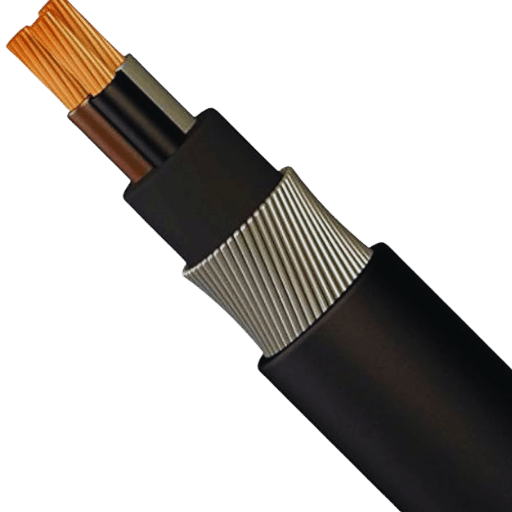
The vertical riser distribution system utilized YJV 4×300mm² and YJV 4×240mm² XLPE insulated power cables. These unarmored constructions were selected for their lighter weight and reduced bending radius—15 times the overall cable diameter versus 20 times for single-core equivalents—facilitating installation within congested riser shafts while maintaining the 90°C temperature rating and 250°C short-circuit withstand capability specified in IEC 60502-1. The 4×300mm² cables were allocated to high-demand floors housing data centers and trading floors, while 4×240mm² cables served standard office levels.
For horizontal distribution at each floor level, we provided YJV 4×185mm² cables capable of delivering substantial branch power with appropriate derating for installation in cable trays. The intermediate distribution boards then fed into terminal circuits using our comprehensive range of single-core wiring: H07V-U hard conductor cables in 1×1.5mm² for lighting circuits, 1×2.5mm² for general power outlets, 1×4mm² for air conditioning units and small equipment, and 1×6mm² for local distribution feeds. For control cabinet wiring and conduit installations requiring greater flexibility, we supplied H05V-K and H07V-K flexible conductor variants in cross-sections ranging from 1×1.5mm² to 1×25mm².
The heavier single-core requirements—H07V-R multi-strand hard cables in 1×2.5mm² through 1×16mm²—were specified for cable tray and conduit installations where installation forces required enhanced conductor integrity without sacrificing the termination advantages of stranded construction.
Certification and Quality Assurance: Beyond Paper Compliance
What distinguished our proposal from competing suppliers was our demonstration of genuine certification depth rather than superficial compliance claims. Our IEC 60502 and IEC 60228 certifications were supported by comprehensive type test reports from accredited laboratories, including high-voltage withstand testing, conductor resistance verification, and mechanical property validation.
We provided the client with detailed factory acceptance test protocols that would be implemented before shipment, including 100% conductor resistance testing and sampling-based high-voltage integrity verification using AC resonance testing equipment. This level of quality documentation proved decisive in the client's risk assessment, as it provided their financing partners with the audit trail necessary for construction draw-down approval.
Technical Support and Installation Engineering
Recognizing that cable specification represents only half the value equation, we deployed our technical engineering team to Abidjan during the critical installation phase. Our specialists conducted on-site training for the local electrical contractor's team, focusing on proper handling techniques for large-section armored cables—specifically addressing the bending radius requirements and pulling tension limits that had caused difficulties in the client's previous project.
For the SWA 4×400mm² installation, we provided detailed cable routing studies that identified optimal pulling sequences and temporary support requirements during the vertical installation. This proactive engineering support prevented the cable damage incidents that commonly occur when installation contractors lack experience with heavy industrial-grade cabling.
Delivery Execution: Precision Logistics Under Pressure
The 47-kilometer cable order was manufactured and delivered in three synchronized shipments to align with the construction schedule, preventing both site congestion and weather-related storage degradation. Our production planning team maintained continuous communication with the client's project managers, providing real-time visibility into manufacturing progress and shipping milestones.
The total delivery comprised:
SWA 4×400mm²: 2.3 kilometers (approximately 51 tons)
SWA 4×240mm²: 4.1 kilometers
YJV 4×300mm²: 3.8 kilometers
YJV 4×240mm²: 6.2 kilometers
YJV 4×185mm²: 8.5 kilometers
Single-core wiring range: 22.1 kilometers across H07V-U, H05V-K, H07V-K, and H07V-R specifications
All cables were shipped on heavy-duty wooden-steel composite drums designed to withstand West African port handling conditions, with moisture-barrier packaging protecting the cable ends during the maritime transit period.
Safety and Compliance: Protecting People and Investment
Electrical infrastructure in high-occupancy commercial buildings demands uncompromising safety margins. Our cable selections incorporated multiple safety-enhancing features: the XLPE insulation systems provide superior overload tolerance compared to PVC alternatives, withstanding emergency operating temperatures up to 130°C without degradation of mechanical or electrical properties. The steel wire armor on primary feeder cables provides not only mechanical protection during installation but also ongoing resistance to rodent damage and accidental impact during building maintenance operations.
Fire performance characteristics were carefully considered: while standard PVC sheathing meets baseline flame retardancy requirements, we offered enhanced fire-performance variants for critical riser applications, ensuring compliance with evolving West African building safety codes that increasingly reference international best practices.
Project Outcomes and Measurable Impact
The electrical infrastructure installation was completed two weeks ahead of the contracted schedule, enabling the client to commence tenant fit-out operations earlier than projected and generating rental income ahead of financial model assumptions. The client reported zero cable-related installation defects during commissioning—a significant improvement from their previous project's experience, where termination issues had required extensive rework.
Post-installation thermographic surveys conducted six months after energization revealed no abnormal heating at cable terminations, validating the quality of both the cable construction and our installation guidance. The SWA 4×400mm² main feeders are operating at 65% of rated capacity under peak load conditions, providing substantial headroom for future tenant expansion without requiring costly infrastructure upgrades.
Why This Partnership Succeeded: Three Distinctive Advantages
1. Certification Authority and Standards Compliance
Our comprehensive IEC 60502 and IEC 60228 certification portfolio, backed by independent laboratory testing and factory quality systems audited to international standards, provided the client with risk mitigation that paper-only compliance claims cannot match. In an infrastructure financing environment where documentation rigor increasingly determines funding availability, our certification depth represented tangible project value.
2. Application Engineering Expertise
Beyond product supply, we functioned as technical partners, translating electrical specifications into installation-ready solutions. Our ability to advise on cable construction alternatives—recommending XLPE over PVC for high-load applications, optimizing conductor sizing for voltage drop constraints, and specifying armoring appropriate to mechanical risk exposure—demonstrated engineering competence that commodity suppliers cannot replicate.
3. West African Market Experience
Our established logistics capabilities and regional market understanding enabled seamless execution in an operating environment where port delays, documentation complexities, and local regulatory requirements frequently disrupt international supply chains. We maintained local technical representation throughout the project lifecycle, ensuring responsive support without the communication delays inherent in distant supplier relationships.
Client Perspective and Continued Collaboration
The project director subsequently communicated that our performance on this development had established the procurement benchmark for their upcoming pipeline, which includes two additional high-rise projects in Lagos and Dakar scheduled for 2025-2026 commencement. They specifically cited the absence of cable-related delays and the proactive technical support as factors that distinguished our engagement from previous supplier relationships.
Partner With Proven Expertise for Your Next Infrastructure Project
Large-scale electrical infrastructure projects in Africa's rapidly developing commercial property sector demand suppliers who combine product quality with project execution capability. Whether your development requires heavy-section power distribution cables like SWA 4×400mm² or comprehensive wiring systems spanning multiple construction specifications, we deliver IEC-certified solutions backed by technical support and logistics precision.
Contact Us today to discuss your project requirements:
Tel/WhatsApp/WeChat: +86 135 1078 4550 / +86 136 6257 9592
Email: manager01@greaterwire.com
 Burundi Bujumbura Post-Disaster Restoration Project



 Building 2, No. 40 Luxi 2nd Road, Liaobu Town, Dongguan City, Guangdong Province, China