


 Home
Home8/3 PVC Jacketed MC Cable with THHN/THWN-2: Features, Ratings, and Applications
 GERITEL
 May 28,2026

In industrial facilities, control cables are the nervous system of your operation. A single damaged cable can shut down an entire production line, costing thousands of dollars in downtime. The two most common causes of control cable failure? Improper bending during installation that cracks the metal armor, and corrosion from harsh industrial environments. This is exactly why 8/3 THHN/THWN-2 PVC jacketed MC cable has become the industry standard for industrial control circuit wiring.
Unlike heavier gauges that are difficult to maneuver in tight spaces or unjacketed options that corrode quickly, this cable is engineered to balance installation flexibility with long-term durability. For industrial contractors, this means faster installations, fewer callbacks, and more reliable control systems for your clients.
1. Why 8/3 THHN/THWN-2 PVC Jacketed MC Cable Is Built for Industrial Control Circuits
· Optimized Conductor Configuration for Multi-Loop Control Systems
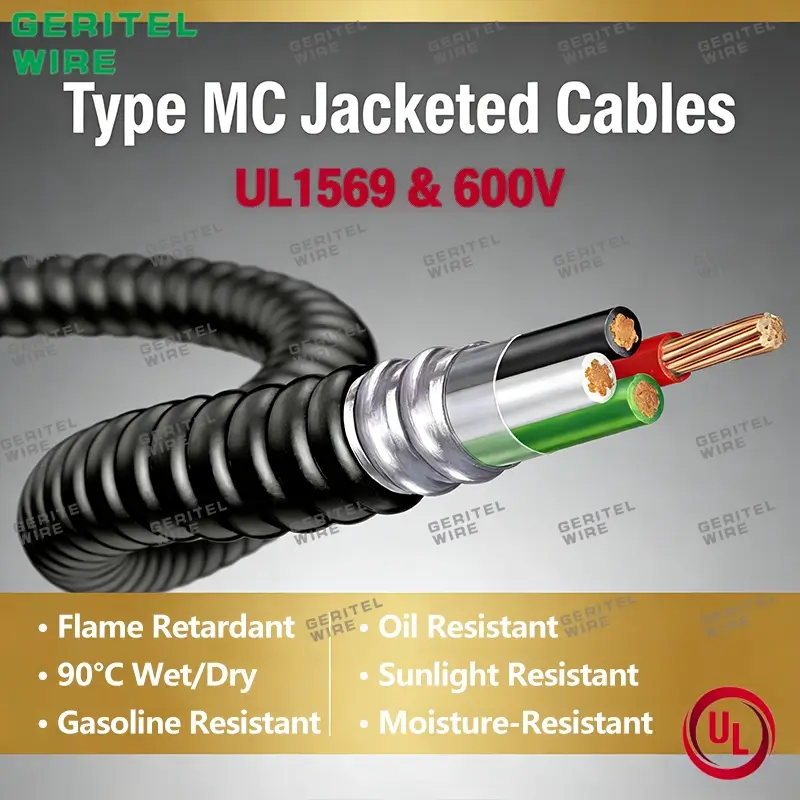
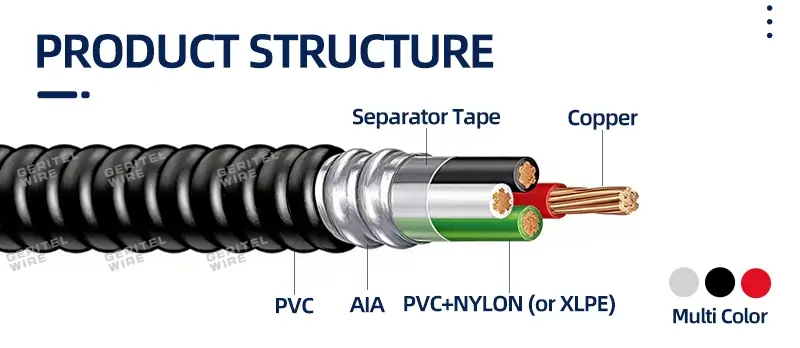
8/3 PVC jacketed MC cable features three current-carrying conductors plus a dedicated ground conductor, making it perfectly suited for the 40A control circuits that power most industrial equipment. This 3/C configuration is ideal for three-phase control circuits, motor starters, and variable frequency drive (VFD) control lines, which are the backbone of modern industrial automation.
The THHN/THWN-2 conductors provide excellent electrical performance and are rated for 600 volt applications, covering nearly all industrial control system requirements. For projects that require additional conductors for signaling or auxiliary circuits, 4/C configurations are also available.
· Flexible Aluminum Armor: Solving Tight-Space Installation Challenges
The biggest pain point we hear from industrial contractors is installing control cables in the cramped spaces inside control panels, motor control centers (MCCs), and equipment enclosures. Standard galvanized steel armor is stiff and difficult to bend, leading to frustration and damaged cable during installation.
8/3 aluminum armor MC cable PVC jacket solves this problem with lightweight, flexible aluminum interlocked armor that has a generous minimum bending radius. This allows electricians to route the cable around corners and through tight spaces without excessive force, significantly reducing installation time and the risk of damaging the armor or conductors.
· PVC Jacket: Corrosion Protection for Harsh Industrial Environments
Industrial facilities are full of corrosive elements: chemicals, oils, moisture, and airborne particulates. Unjacketed MC cable relies solely on its metal armor for protection, which can corrode rapidly in these conditions, leading to exposed conductors and control system failures.
The thick PVC outer jacket on 8/3 MC cable with PVC jacket and ground provides an impenetrable barrier against these corrosive elements. This extra layer of protection extends the cable’s service life by 2-3 times in harsh industrial environments, reducing maintenance costs and minimizing unplanned downtime.
2. Non-Negotiable Applications for 8/3 MC Cable in Industrial Wiring
· Industrial automation control loops: Powers PLCs, sensors, and actuators in manufacturing and processing facilities
· Motor control center (MCC) wiring: Connects motor starters and VFDs to industrial equipment
· Factory instrumentation and process control: Transmits control signals for temperature, pressure, and flow monitoring systems
3. The Critical Bending Radius Guide: Avoid Costly Armor Damage
The single most important rule when installing aluminum armor MC cable is to never exceed the minimum bending radius. Excessive bending will crack the interlocked armor, compromising its mechanical protection and creating a potential safety hazard.
For 8/3 PVC jacketed MC cable, the minimum bending radius is 7 times the overall diameter of the cable. When making bends:
· Use your hands or approved cable benders, never pliers or other sharp tools
· Make gradual, smooth bends instead of sharp, right-angle turns
· Avoid running the cable over sharp edges or corners without proper protection
· Leave extra slack at both ends to accommodate future adjustments
4. Selection Checklist for Industrial Control Projects
· Conductor type: For most indoor industrial control circuits, THHN/THWN-2 conductors provide the best balance of performance and cost. XHHW-2 conductors are recommended for applications with higher moisture exposure.
· Ground configuration: Choose between bare ground and insulated green ground conductors. Insulated green ground is preferred in industrial environments for easier identification and additional protection.
· Armor type: Aluminum interlocked armor is the standard for most control circuit applications due to its flexibility. Galvanized steel armor is only necessary for areas with extreme mechanical abuse.
5. Three Common Installation Mistakes That Ruin Control Cables
· Over-bending the cable: This is the #1 cause of aluminum armor damage. Always measure and mark bends before making them, and never force the cable into a tight radius.
· Skipping the PVC jacket in corrosive environments: The small upfront cost savings of unjacketed MC cable will be completely erased by the cost of replacing corroded cables in just a few years.
· Using incorrect connectors: Always use MC cable connectors that are specifically designed for aluminum armor and provide a secure, watertight seal.
6. FAQ
· What is the maximum ampacity of 8/3 THHN/THWN-2 PVC jacketed MC cable?
8/3 THHN/THWN-2 MC cable is rated for 40 amps at 600 volts, making it suitable for most medium-power industrial control circuits.
· What is the minimum bending radius for 8/3 aluminum armor MC cable?
The minimum bending radius is 7 times the overall diameter of the cable. Always refer to the manufacturer’s specifications for exact values.
· What is the difference between 8/3 and 8/4 MC cable?
8/3 MC cable contains three current-carrying conductors plus a ground conductor, while 8/4 contains four current-carrying conductors plus a ground conductor. 8/4 is used for applications that require an additional control or signal conductor.
· Do I need conduit for 8/3 PVC jacketed MC cable?
No, the aluminum interlocked armor provides the necessary mechanical protection, so conduit is not required for most indoor industrial installations. This significantly reduces installation time and labor costs.
7. Get Technical Support & Project Pricing
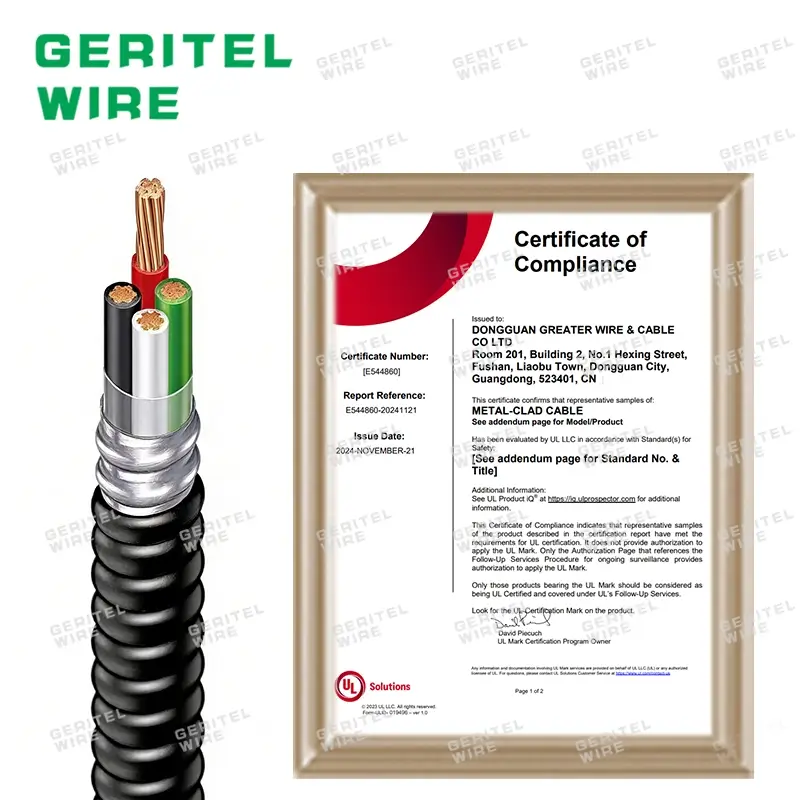
At Greater Wire, we specialize in supplying high-quality 8/3 PVC jacketed MC cable for industrial control system projects. Our cables are manufactured to strict industry standards, and our team of electrical experts can provide technical support to help you select the right cable for your specific application.
If you are working on an industrial wiring project and need help with cable selection, or if you would like to request a competitive quote, contact our team today. We will work with you to ensure your project is completed on time and on budget.
Dongguan GERITEL Electrical Co., Ltd.
Tel/WhatsApp/Wechat: +86 136 6257 9592
Tel/WhatsApp/Wechat: +86 135 1078 4550
Email: manager01@greaterwire.com
Website: www.geritelgroup.com
 PVC Jacketed MC Cable Manufacturer Guide: Specs, Models, and Export Terms for U.S. Buyers



 Building 2, No. 40 Luxi 2nd Road, Liaobu Town, Dongguan City, Guangdong Province, China